
This was on broadcast via the Mayor of London website. We recommend you watch the discussion, which is available online.
Today’s discussion is first of all centrally discussing Secured by Design, who advocate closing more roads and implementing closing through roads as safety measure, which was opposed by other panel members.
The police’s role in the planning process is being discussed, as police promote Secured by Design. Secured by Design is said to reduce crime by up to 87% in relation to burglary.
Which issues could be affecting the amount of burglaries and it is questioned what reductions are due to design issues rather than other factors.
It is said that the program reduces ASB but academic research is missing says a spokes person.
Evaluating the police’s role in the planning process, about the GLA view. Metrics and measures need to take a longer term view about this. Mozart Estate in Westminster is given as example. GLA should be looking over time on the consequences of planning. People who live in the estate are the best indicators about what’s going on. Designers need to find out about design performance by surveying the residents of the area.
Limitations of the police, London boroughs work in 32 different ways. Whilst Haringey works very closely with police from an early stage, others do not.
New built blocks of flats need to be fitted into existing walk ways, there is no option to create street design around the block.
Secured by Design was formed over 20 years ago, under the Association of Chief Police Officers, the National Police Chief’s Council is unable to own it. MOPAC stepped in to take over of the organisation at the point of the dissolution of the Association of Chief Police Officers.
Secured by Design was invented in 1989 and there are hugely successful communities despite not following the principles in the SBD guidance, is mentioned by a participant.
A critical remark was that security measures were too secure, so that people gotten locked out, were unable to use too heavy doors or parks were altered to remove lovable aspects of them.
Any safety policy must be flexible and address constantly changing environments and changing crime patterns.
I agree that busy routes and places are often the best protection against crime because criminals like the quiet places, that help them keep their anonymity. Perhaps the problems lies in the strict separation of business and housing areas. Just to give examples of how the area of Brick Lane is mixed housing, shopping, dining areas, which are keeping the place busy and act as protecting layer or all those using it. Whilst estates, which are housing only and have not much through footfall or drivers using the roads, create isolated foot paths and scarcely used walk ways, which are often loved by criminals and those affecting ASB.
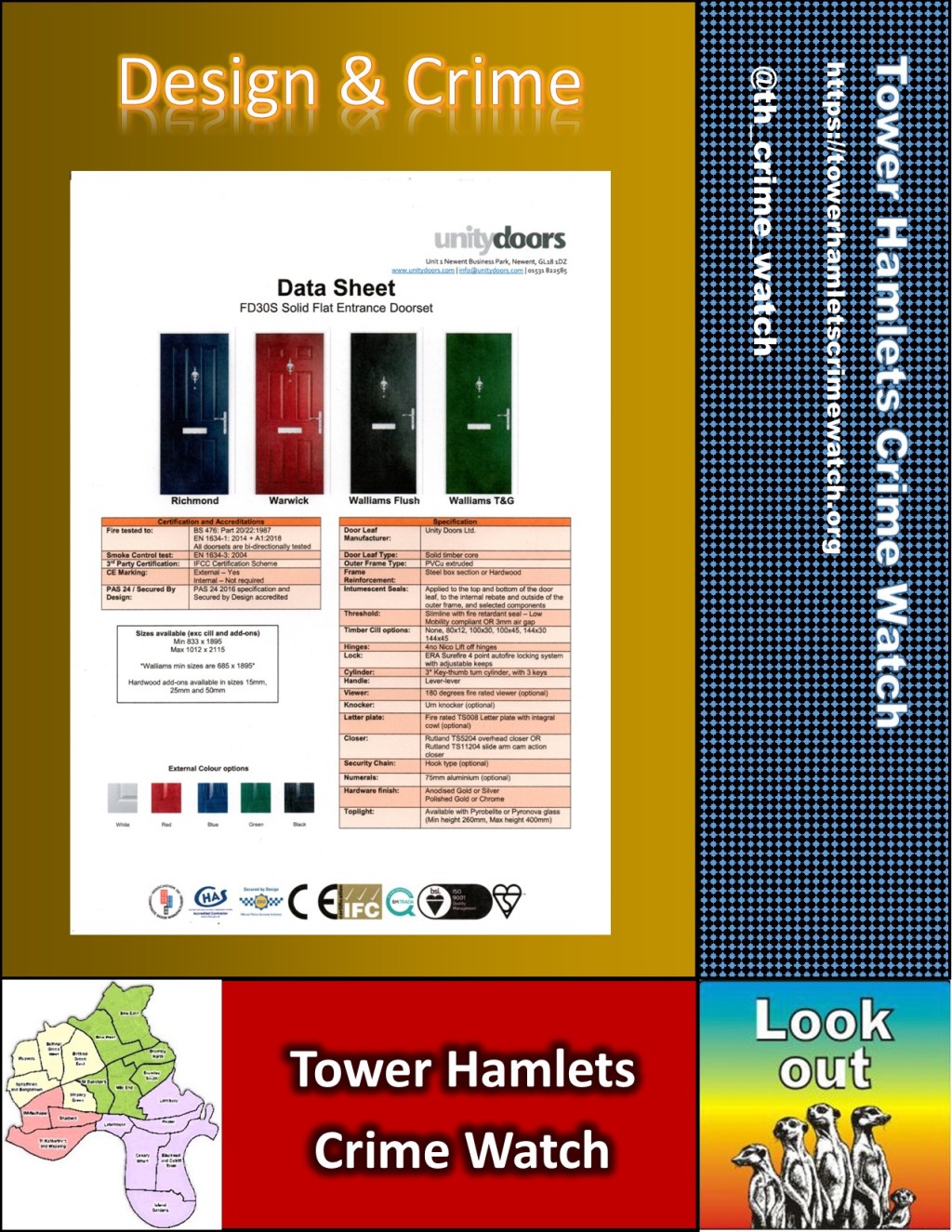
Panel members agree that we cannot design out crime as many social factors play a role. Looking at the security door in the title picture reminds me that on Council estates for example, it’s the social housing provider who gives those new security doors to tenants and leaseholders who can pay but many cannot afford or do not want to put the safety doors in. So overall safety depends also on the ‘across-the-board’ equally strong safety measures.

 Tower Hamlets Crime Watch