

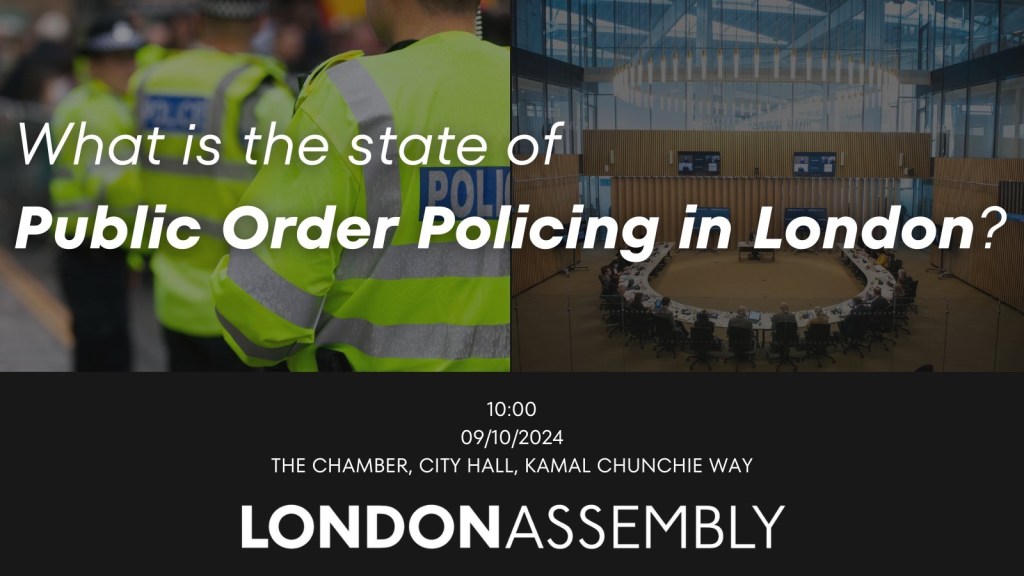
We strongly recommend that you watch in full today’s discussion of the London Assembly talking about the Police’s role in policing demonstrations and protests as well as public events. The length of time it takes to process prosecutions. It’s been mentioned that the Police themselves did not do enough to explain their decision-making processes, which led to their style of policing.
The popular conception of two-tier policing is defined according to Grok on X as follows:
The concept of “two-tier policing” has gained traction in public discourse, especially within the UK, suggesting that law enforcement applies different standards based on various factors, including political alignment, ethnicity, or the nature of the protest or crime. Here’s a balanced look at this issue based on the information available up to October 9, 2024:
- Public Perception and Political Rhetoric: There’s a significant amount of discussion on platforms like X where individuals, including notable figures like Elon Musk, have propagated the idea of two-tier policing. This rhetoric often highlights perceived leniency towards certain groups, typically those associated with progressive causes or minority groups, compared to more stringent treatment of others, notably those on the far right or involved in riots. This narrative has been criticized by some as oversimplified or politically motivated, aiming to discredit movements or paint a picture of systemic bias in policing.
- Policing Challenges: The policing of large protests, especially those related to controversial issues like the Israel-Palestine conflict, has been highlighted as particularly challenging. Critics argue that while smaller, less organized groups might face more aggressive policing, larger, often more politically or socially sensitive protests might receive what’s perceived as softer handling due to the scale of operations required or political sensitivities.
- Legal and Institutional Response: Senior politicians and police chiefs have largely dismissed the notion of two-tier policing as myth or misrepresentation. They argue that what might be perceived as differential treatment is often a response tailored to the context, size, and nature of the events. For instance, handling a small group of rioters might look more aggressive due to the immediate threat to public order compared to managing a large, mostly peaceful protest where the strategy might involve containment and less direct confrontation.
- Cultural and Institutional Bias: Critics of the current policing system, including some within the police force, have pointed towards an institutional bias influenced by societal trends towards inclusivity and anti-racism. This perspective sees current policing strategies not just as operational but as culturally influenced, where efforts to combat racism or improve diversity might inadvertently lead to perceptions of different treatment for different groups.
- Public Disorder and Policing Tactics: The riots following certain events, like the Southport case, where misinformation fueled violence, showcased a scenario where police response was criticized for being either too aggressive or not proactive enough, depending on the observer’s perspective. This highlights how public disorder, especially when politically charged, can lead to perceptions of two-tier policing based on how different groups are handled.
- Institutional Integrity and Public Trust: The debate around two-tier policing also touches on broader issues of trust in police institutions. Claims of differential treatment can erode public trust, making policing more challenging. Conversely, efforts to demonstrate impartiality and adherence to law can sometimes be misinterpreted as bias, especially when policing decisions are made under the public eye and political scrutiny.
In summary, while there’s ample discussion and concern over what might be termed “two-tier policing,” the reality appears more nuanced. It involves operational necessities, public order management, political sensitivities, and institutional efforts towards inclusivity, all of which can be perceived as differential treatment but might not necessarily reflect systemic bias in the way critics suggest. However, the conversation itself underscores a need for policing strategies that maintain public trust, ensure impartiality, and adapt to the complexities of modern societal issues while upholding the law.

 Tower Hamlets Crime Watch
3 responses to “Two-tier policing”
If we cannot ‘rubbish’ our police force – where the statistics speak for themselves – on social media, where can we do this? On the streets? 🤷
As, the same applies to the NHS – NOT every department of it is rotten and beyond help.
If, as you stated, we must ‘work in partnership with (the) police’ – some parts of it, is beyond ‘working with them’ – only a ‘root and branch’ curretage and pruning, will be the most obvious and economical solution – one is minor and the other a major procedure or process. This is short of pressing the RESET button.
If, as you said, we work in partnership with the police, then perhaps maybe (just maybe) – which in my humble opinion, we already have been doing so as Volunteer Police Officers and Police Staff – within the Police Forces throughout the UK, since the Bow Street Runner days; then maybe (just maybe), we may already know where the problem areas are within our police force.
Just ‘putting more boots on the ground’ is NOT the longterm solution we are seeking.
It’s like deciding whether to add herbicides or fertilisers to an already sick tree.
We, as hardworking taxpayers’, deserve better.
LikeLike
We must stop blaming the police, they are not the problem. We need more not less officers. We need less shoving blame onto the police by politicians who seek an easy way out.
LikeLike
[…] Our only remaining Conservative Councillor constantly criticises police and that is not helpful to me, as I think that working in partnership with police is much more helpful than to try and rubbish them on social media. In that context please read the latest article on Tower Hamlets Crime Watch on Two-Tier Policing. […]
LikeLike