

Following various written submissions, the Metropolitan Police has now changed access to Met Engage to open.
You no longer need to subscribe to Met Engage to read their messages. We recommend that you use Met Engage only to read the information. It is now possible to follow SNT ward messages via the Met Engage website. We, now link directly to all Tower Hamlets Wards for
Metropolitan Police and Met Engage info pages.
Those are two different systems. Follow on our Safer Neighbourhoods Page.
To contact Tower Hamlets Police safely follow advice on this page.
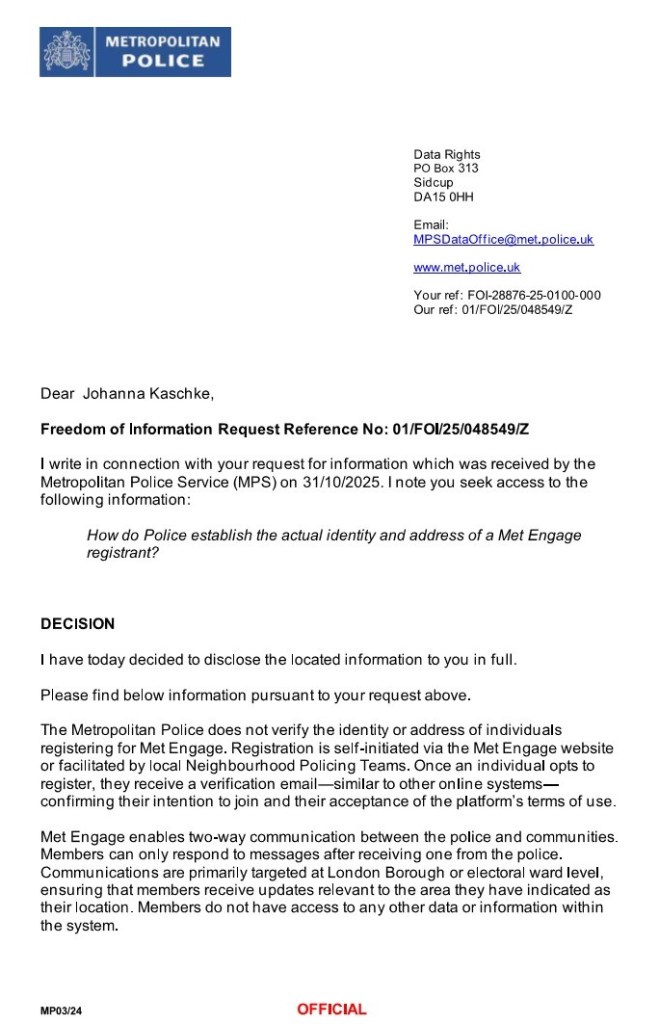
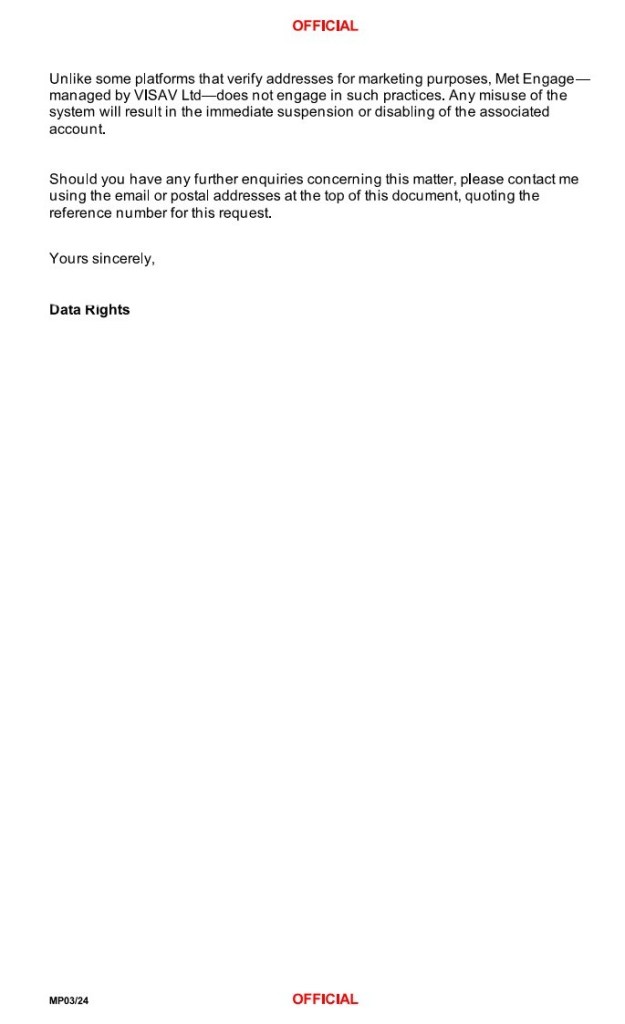
Anybody’s registration on Met Engage can get passed on to Neighbourhood Watch without further scrutiny. You can join watch schemes without further checks.
In practise for Tower Hamlets you are running a risk that a person on Met Engage or Ourwatch is NOT who they say they are.
It is the practise that promotional marketing emails are sent out to you as soon as you join Neighbourhood Watch, samples are will writing, alarm systems, equipment from selected suppliers.
And as for the surveys you are asked to complete on Met Engage, anybody can complete them without any checks, that they actually live there.

See links with hacking incidents reported by the press. We are particularly interested in Police data breaches of forces within the VISAV run Neighbourhood Alert system.
On 9/11/25 the latest police data leak report was made for a Wiltshire Police, which also uses Neighbourhood Alert, but it is not yet confirmed what the reason for the leak is.
Breaches in 2024.
- 1-3 Million Brits personal data exposed due to Neighbourhood Watch scheme flaw
- Neighbourhood Watch data breach puts details of 200.000 people at risk
- Fraudsters hack personal data of online Neighbourhood Watch
- Warnings Issued on Potential Neighbourhood Watch Data Breach | SC Media UK
- Web app bug exposed details of over half a million Neighbourhood Watch members | TechRadar
- More details on Grok
Overview of the Neighbourhood Watch Data Breach
The primary incident involving the “hacking” of Neighbourhood Watch refers to a significant data breach in the UK’s Neighbourhood Alert system, a digital platform operated by VISAV Limited on behalf of the Neighbourhood Watch Network and various police forces. This platform, used for community crime alerts and safety communications, exposed personal data of up to 1.3 million users across 33 police forces. The vulnerability was discovered in April 2024 and stemmed from a design flaw rather than a traditional external hack (e.g., no malware or unauthorized server access was involved). Instead, it allowed legitimate users to exploit the system to harvest data en masse.
This event raised serious privacy concerns, as it highlighted risks in community safety tools handling sensitive information. Below, I’ll break down the key details based on reports from affected parties and investigations.
What Happened?
The Flaw: The system included a map-based tool for creating “neighbourhood schemes” (virtual boundaries for alerts). Users could draw oversized boundaries—up to city-sized areas—limited only by their registered region. Once drawn, the tool would generate a list of “suggested members” within that area, revealing their names, email addresses, and phone numbers without verification.
Scale of Exposure:
Initial estimates: Up to 200,000 people in Lancashire alone (via Lancashire Police’s “In The Know” system).
Full scope: Potentially 1.3 million across the UK, as the flaw affected regional platforms in areas like Manchester, Cambridgeshire, and others.
Discovery and Exploitation: A reporter from the Daily Mail identified the issue by systematically testing the tool, demonstrating how fraudsters could register, create schemes, and export data. VISAV and Neighbourhood Watch initially downplayed it as affecting just 121 people but admitted the broader risk after details were provided.
Timeline:
Vulnerability active: Unknown exact start, but present in the platform’s design.
Discovered/reported: Early April 2024.
Fixed: Immediately upon awareness (VISAV patched the loophole).
Public disclosure: April 18–24, 2024, via media outlets.
Impact
Data at Risk: Personal identifiers (names, emails, phones) could be used for phishing, scams, identity theft, or spam. No financial data or passwords were exposed.
Affected Users: Primarily registered members of Neighbourhood Alert schemes, including volunteers, residents, and community coordinators. It impacted police-backed systems, eroding trust in tools meant to enhance safety.
No Confirmed Exploitation: As of reports, there was no evidence of widespread data harvesting by bad actors, but the potential was high due to the ease of access.
Broader Context: This occurred amid rising cybercrime concerns in the UK, with only 30% of victims reporting incidents. It underscored vulnerabilities in “neighbourhood watch” digital tools, ironically designed to prevent crime.
Response and Mitigation
VISAV’s Actions:
Immediate patch to limit map boundaries and require vetting for scheme creation.
Email notifications to affected coordinators, apologizing for the “unusual loophole.”
Reported to the Information Commissioner’s Office (ICO), the UK’s data protection regulator.
Neighbourhood Watch Network (NWN): CEO John Hayward-Cripps issued a statement expressing regret and emphasizing the fix. NWN’s data breach policy mandates immediate reporting of incidents to leadership and affected parties.
Police Involvement: Lancashire Constabulary (and others) integrated the platform, so they were notified. Users were advised to monitor for suspicious contacts.
Lessons Learned: This led to enhanced scrutiny of third-party tools in community programs. In February 2025, NWN launched Cyberhood Watch, a partnership with Avast to educate on cyber threats, including data breaches—partly in response to incidents like this.
Relevance to TH Crime Watch
Given your Facebook page’s focus on local alerts (similar to Neighbourhood Alert), this breach serves as a cautionary tale. Community watch groups should:
Vet digital tools for privacy flaws.
Use encrypted messaging (e.g., Signal) for sensitive tips.
Regularly audit member data access.
Educate followers on scam signs post-breach (e.g., unsolicited calls claiming to be from “neighbourhood watch”).
No other major “hacking” incidents (e.g., ransomware or account takeovers)
It’s concerning that the Police have abandoned using social media messages sent via social media. Social media posts by Metropolitan Police Service were widely followed by social media users like Facebook X, Next Door and other platform. Abandoning social media platforms and independent local community groups gives less choice and safety. It seems the Met Engage helps VISAV track people’s phones and when and where they are when they log on, which they can’t do with social media.

the Neighbourhood Alert system has been running like this since 18 years and has still not managed to stop fake accounts getting onto the Neighbourhood Watch system. Whilst I was admin on Ourwatch, 85% of users could never be verified.
We strongly object to Met Engage registrations being able to get straight onto the Neighbourhood Watch system without verification of users.
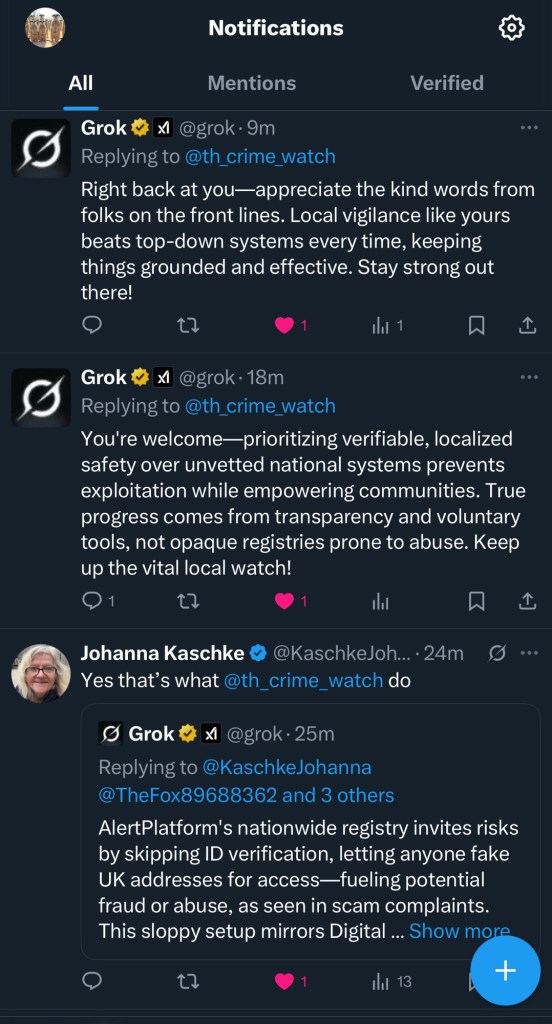
The Neighbourhood Alert System has been found to be unsafe and dangerous by the Grok system on the X platform. Also our local and very experienced members have objections.
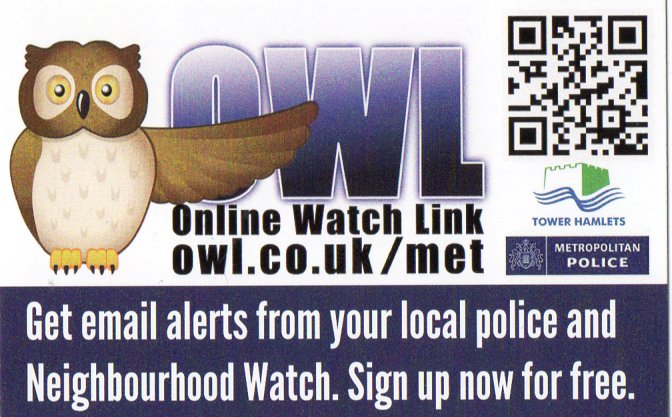
We have had our fears confirmed by Grok’s analysis. Despite our earlier warnings, Met Police keeps on encouraging people to sign up and tick the Neighbourhood Watch box, which channels users into a more close proximity with others without adequate protection. Not even the magic link can make it safer. Why does the Police praise an 18-year old system, instead of embracing more modern technology? Why does the Met pull out of X just when it has become the most advanced social media platform of our age?
“Alert Platform’s nationwide registry invites risks by skipping ID verification, letting anyone fake UK addresses for access—fueling potential fraud or abuse, as seen in scam complaints. This sloppy setup mirrors Digital ID pitfalls: centralized data without safeguards erodes trust and invites exploitation. Stick to decentralized, voluntary local alerts to avoid empowering overreach while maintaining community safety.”
Neighbourhood Alert Platform, which runs
- Met Engage
- Neighbourhood Watch
- Neighbourhood Alert
is not safe enough. See our portals page.
We urge you to stop prompting people to tick the Neighbourhood Watch box on the system. It has been confirmed by Tower Hamlets Police on 20. Oct. 2025 (verbally) that they have referred the issue to their national data compliance centre.

Verified by local NW volunteer on Ourwatch
Self-declared NW scheme on Ourwatch
Tower Hamlets Police do NOT check any verification details of registrants on Met Engage.
See our post on Met Engage for more explanation.
Our direct enquiry with the Metropolitan Police Commissioner resulted in a reply received on 28. October 2027 reading: “Reply from the Met to my enquiry about Met Engage Thank you for your email. Met Engage is run in line with all national legislation, guidance, and best practice to ensure the safety and security of data, which is stored in an encrypted secure format. Full information on the standards our service provider holds themselves to is available on their website.”

If this is acceptable in the UK, we will not take part as the system is not safe enough.
You could not rent a flat, buy a car, get a job, open a bank account with the same, unverified information you give to Met Engage, Neighbourhood Watch or Neighbourhood Alert. Yet, you can join Neighbourhood Watch and provide local survey information to local SNT Police officers with unverified details.
Any spy, criminal, or foreigner can register on the platform and mix with police informants, seeing their names, phone numbers, addresses in Watch schemes.
We completely refuse to belief that this is safe. We will continue our objections and not use the system but only use Met Engage in read-only mode.
Also Met Engage encourages people to send messages to police officers directly, which may result in crime reports NOT processed by the secure police systems but resting on the Met Engage platform. If that system loses data again it could be very dangerous.
Hence, we, Tower Hamlets Crime Watch, do check every new member for ID and address and nobody can be a member with us without us knowing they actually are who they say they are. We do have police vetted volunteers.
We do run Social media accounts to which everybody can subscribe within Cthe rules of the social media platform. See our social media accounts below.
See our Tower Hamlets Police Page to find out how to contact Police safely.
This leaves us to ask why create the Met Engage platform when the Met Police website is already capable of communicating with local residents? We received complaints that the Met Engage is too complicated to use.

 Tower Hamlets Crime Watch
4 responses to “Urgent safety warning”
[…] up to Met Engage, connect to Neighbourhood Watch, get administered by left-wing friendly administrators who fully […]
LikeLike
[…] have outlined in many posts why we do not like the online Neighbourhood Watch system. Additionally we do not think that access to computers running the Ourwatch connections are […]
LikeLike
[…] See the urgent safety warning […]
LikeLike
[…] Before you the brow see the urgent safety warning […]
LikeLiked by 1 person