

We understand that the Mayor of London has declared that
- London hotspots get increased Police officers
- Business areas get more patrols
- 100s more officers on patrols
These are extra measures to protect business and hotspot areas.
Tower Hamlets Council now employs over 70 THEO officers, who cost more and have less power than regular Police officers. See the table below and if you feel that
- THEOS go over their sanctioned scope of authority
- crimes in your area are not dealt with adequately
- please feel free to upload your evidence to us.
We have obtained the latest ward panel handbook for officers and have the older version for the public on our Ward Panels page.
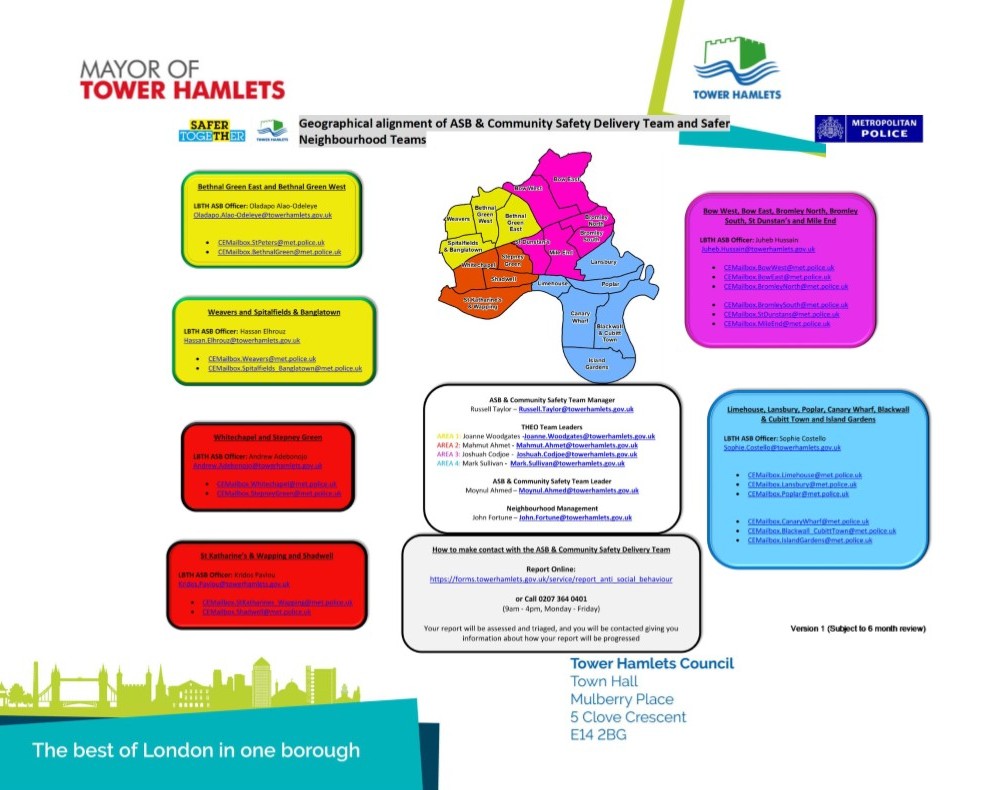
See our Safer Neighbourhoods Page and it shows that each ward is colour-marked, according to the Policing ward structure.
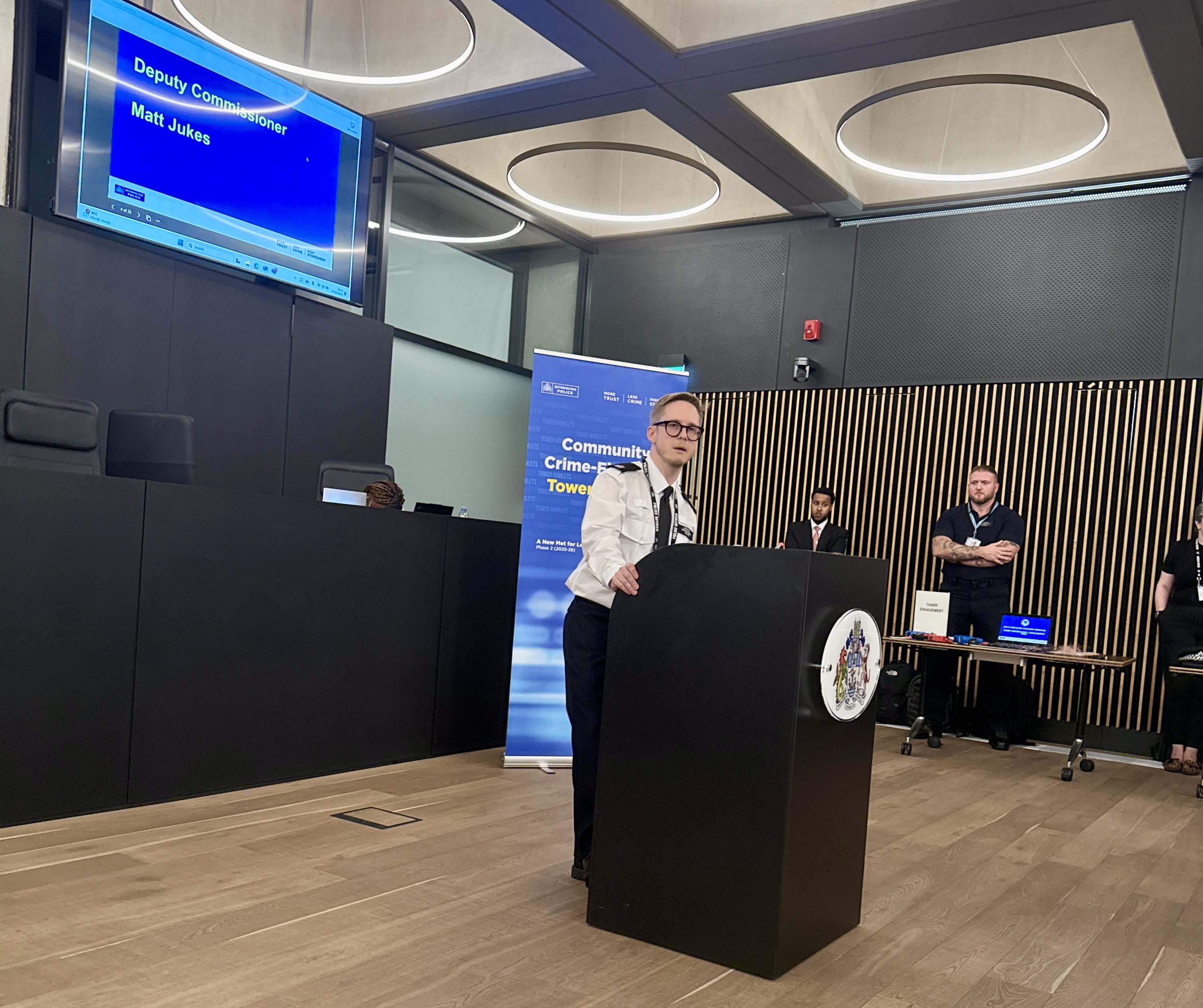 We have been informed by Detective Superintendent Oliver Richter, that he plans to revive ward panels in 2026 to their former functionality. See our event calendar or Safer Neighbourhoods page for Ward Panel meetings.
How is policing of crime and ASB in Tower Hamlets organised?
Tower Hamlets Police has a number of officers and each ward should have a dedicated officer for Neighbourhood Policing. If you visit the Safer Neighbourhoods Page, then click on your ward and you get transferred to the relevant ward on the Metropolitan Police website, which lists all your officers. You can then choose to contact your team or name a particular officer you wish to speak to.
Powers of PCSOs and THEOs
Tower Hamlets Council employs THEOS, currently around 70+
The question is would it not be more efficient to employ more fully empowered police officers instead?
Use our form to upload film or picture of your personal experience with drug related crime in Tower Hamlets. This may include gas canisters, other left-overs and/or ASB evidence.
Overview
Police Community Support Officers (PCSOs) are uniformed members of police forces in England and Wales, created under the Police Reform Act 2002 to support frontline policing with a focus on neighbourhood issues like anti-social behaviour (ASB) and low-level disorder. They have a defined set of designated powers but lack full police authority.
Tower Hamlets Enforcement Officers (THEOs) are civilian employees of the London Borough of Tower Hamlets Council, introduced in 2009 to tackle ASB, environmental crime, and community safety issues. They operate under the Community Safety Accreditation Scheme (CSAS), which allows local authorities to accredit civilians with limited, police-approved powers. THEOs work closely with the Metropolitan Police but are not part of the police service.
Both roles emphasise visible patrols and community reassurance, but PCSOs have broader, more standardised policing powers, while THEOs’ authority is narrower, council-specific, and focused on enforcement and support.
Key Powers of PCSOs
PCSOs have 20 standard powers (designated by chief constables under the Police Reform Act 2002 and Policing and Crime Act 2017), plus optional additional ones based on local needs. These include:
- Detention and Identification: Detain suspects for up to 30 minutes pending police arrival; require name and address for suspected offences (e.g., ASB under Section 50 of the Police Reform Act 2002).
- ASB and Disorder: Issue fixed penalty notices (e.g., for littering, graffiti); seize alcohol in designated public places; issue Community Protection Notices.
- Traffic and Environment: Stop vehicles for roadworthiness checks or authorised road checks; enforce parking and traffic orders (powers of a traffic warden); issue litter fines.
- Other Enforcement: Powers related to truancy removal, tobacco sales to minors, and closure notices for premises selling alcohol to children.
- Limitations: No full arrest powers (can request police arrest); no stop-and-search (under PACE); no interviewing suspects or handling high-risk operations. Some forces equip PCSOs with handcuffs or CS spray, but this varies.

Yet, despite not having any powers to stop or search any vehicles nor arrest or confiscate, the THEO’s made up a ten officers strong team to stop one moped with a few small bags of cannabis. 9/12/25
PCSOs must wear marked uniforms and can use reasonable force in specific circumstances.
Key Powers of THEOs
THEOs are accredited under CSAS, granting them a subset of powers typically limited to low-level enforcement. Their role prioritises patrols, fines, and referrals, with training in community safety, first aid, and outreach (e.g., for substance misuse). Powers include:
- Identification and ASB: Under Section 50 of the Police Reform Act 2002, require details from individuals suspected of ASB, drugs, or violence.
- Fines and Seizures: Issue fixed penalty notices for environmental crimes (e.g., littering, fly-tipping) and ASB; seize alcohol or seize items related to drug-related ASB.
- Council-Specific Enforcement: Support injunctions for gang-related ASB; close illegal raves or drug dens via council powers; refer individuals to support services (e.g., for homelessness or addiction).
- Other: High-visibility patrols with CCTV teams; work with police on drug squads (e.g., using K9 units for seizures); no arrest powers.
- Limitations: No detention powers; cannot conduct searches or handle serious crime independently. They focus on prevention and support rather than investigation, and their accreditation is revocable by the police.
THEOs do not require prior policing training and earn around £35,000–£38,000 annually, higher than starting PCSO salaries. of £32,000 – 35,000.
Comparison Table
| Aspect | PCSOs | THEOs |
| Employer | Metropolitan Police | Tower Hamlets Council |
| Wages | PCSO start ~33,000 PC start £42,210 | THEO start # £36,000 THEO annual £42,720 |
| Core Focus | Neighbourhood Policing, ASB, minor offences, intelligence gathering | ASB, environmental crimes, drug outreach, community support |
| Standard Powers | 20+ (e.g. 30 min. detention, vehicle stops, litter fines, alcohol seizure. | Limited CSAS (e.g., name/address requirement, fines for ASB or environmental issues) |
| Arrest/Detention | limited detention up to 30 mins, request police arrest | None |
| Search powers | None (cannot stop a. search) | None |
| Enforcement tools | Fixed penalties, notices, some equipment (e.g., handcuffs in select forces) | Fixed penalties, seizures, injunction support; no equipment like sprays |
| Training | 4-11 weeks, incl. use of force, evidence handling, radio procedure | Community safety, first aid, outreach; no mandatory policing training |
| Scope | broader policing integration; can support crime scenes, traffic surveys | Council-led, patrols with police but focused on local bylaws and referrals |
| Limitations | No full arrest, interviews, or high-risk tasks | Narrower, non-police remit; cannot handle civil disorder independently |
Key Differences
- Breadth of Authority: PCSOs have more comprehensive powers for direct intervention (e.g., vehicle stops, truancy powers), making them more versatile in policing scenarios. THEOs’ powers are a smaller subset, often overlapping with PCSO ASB tools but tied to council priorities like environmental enforcement.
- Integration and Accountability: PCSOs are police staff, integrated into response teams and subject to police discipline. THEOs report to the council, collaborate with police (e.g., via joint patrols), but lack police oversight, leading to criticisms of fragmented roles during events like riots.
- Community Role: Both reassure residents, but PCSOs emphasise intelligence and problem-solving, while THEOs blend enforcement with support (e.g., referring drug users to services).
- Effectiveness Context: In Tower Hamlets, THEOs complement PCSOs by filling gaps in council-funded areas like drug squads, contributing to reported ASB reductions (e.g., 39–50% in recent years). However, PCSOs provide a more “policing-like” presence.
In summary, PCSOs hold superior powers for operational policing, while THEOs offer targeted, cost-effective council enforcement with a welfare focus. For specific incidents, both often defer to full police officers.
Ward policing
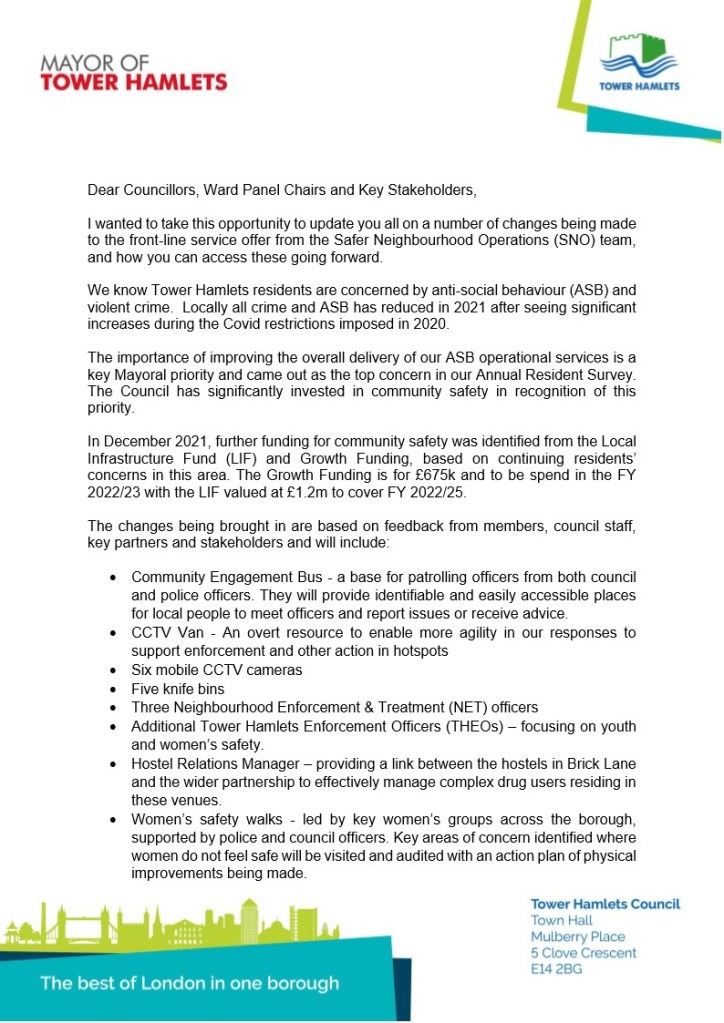
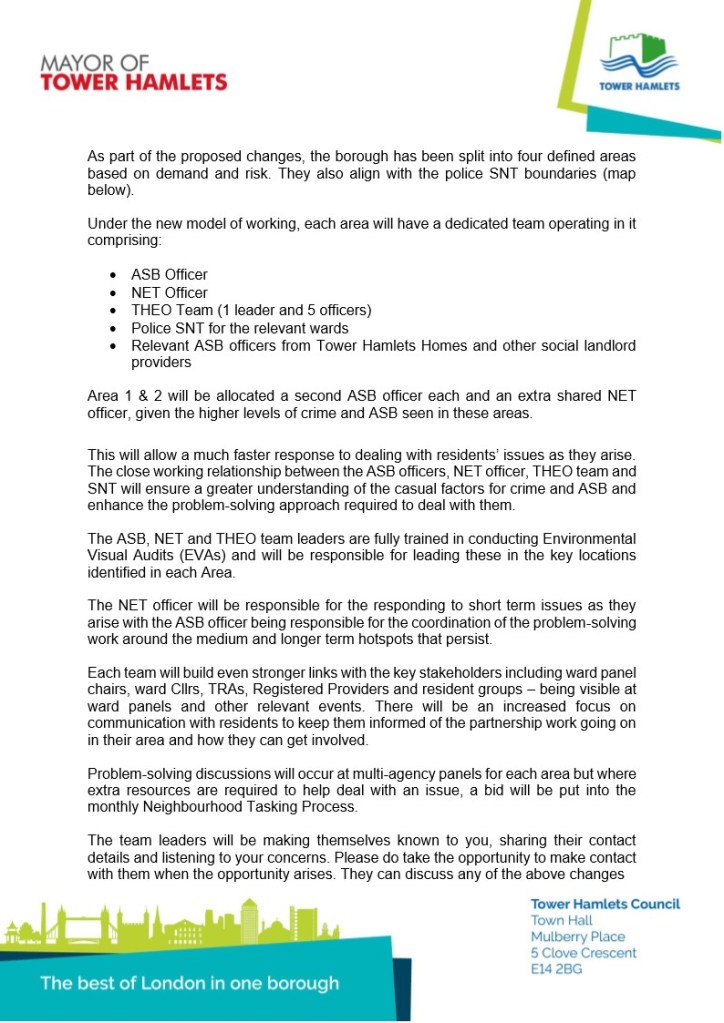
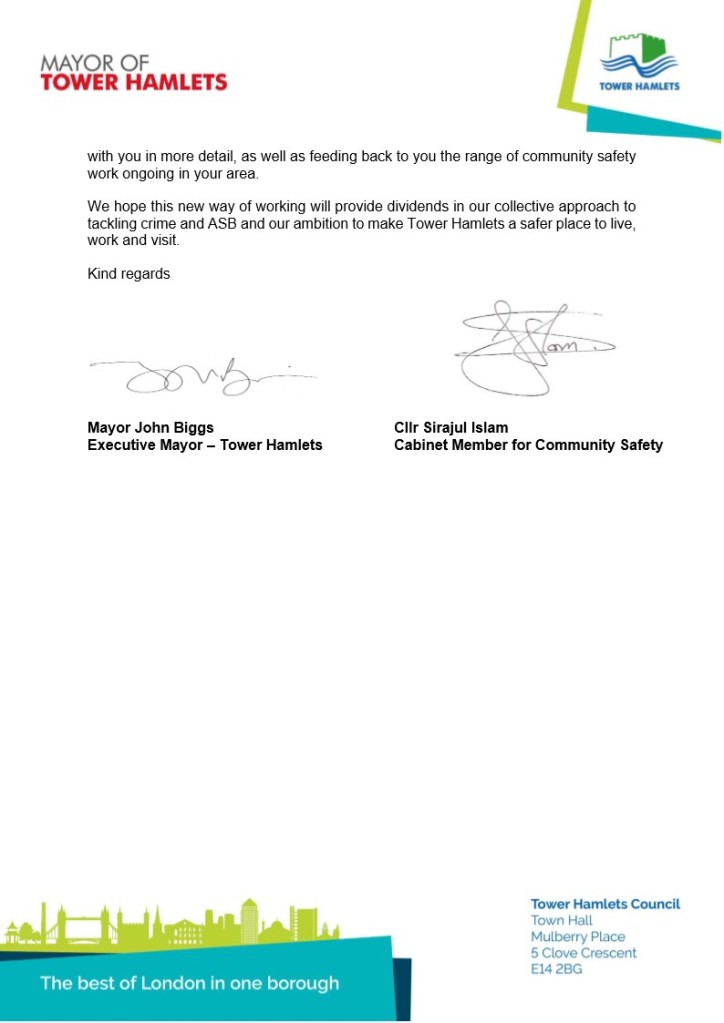
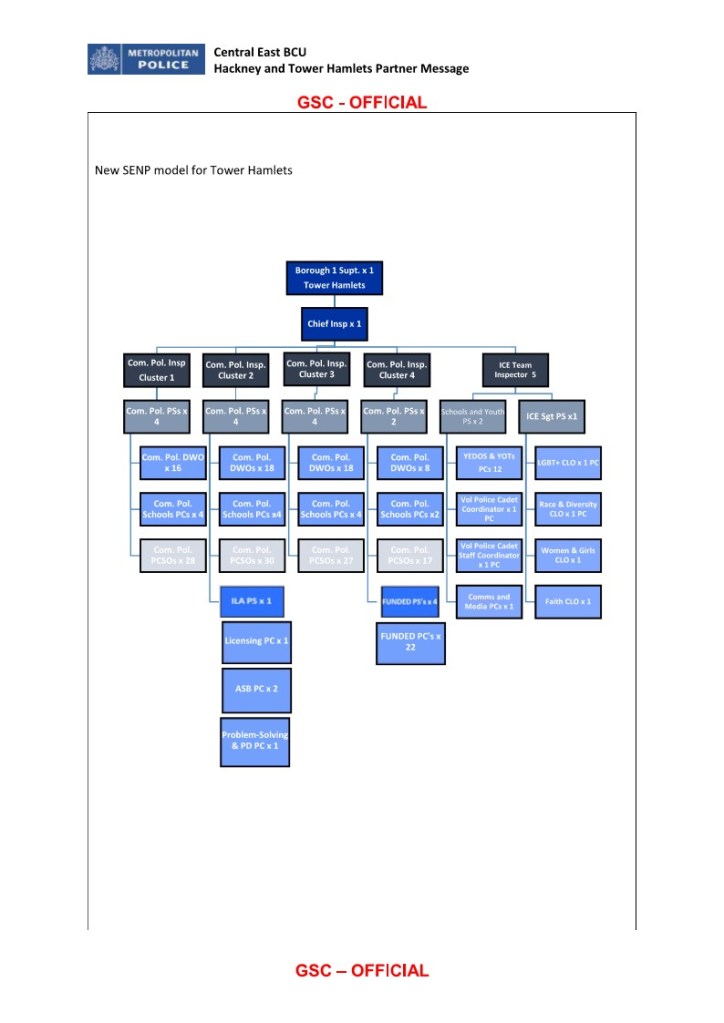
How the wards are policed is currently in discussion. The Council and Tower Hamlets Police have produced various structure documents, which vary slightly, there is another document for the parking zone areas, similar to SNT wards.



Anti Social Behaviour
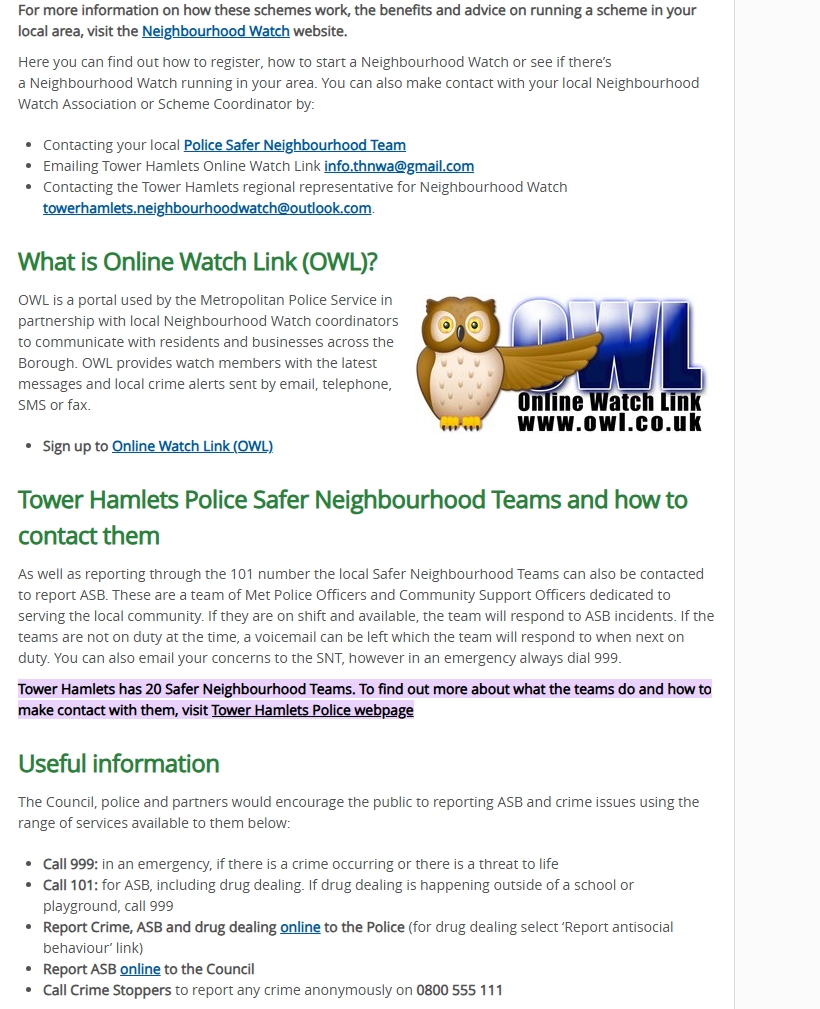
is dealt with by a variety of agencies starting with your landlord if you have one. You complain to the landlord, to the Council and to police, depending on the kind of problem you have. See our ASB page.
29/10/25 – The Tower Hamlets Council admits here: “The Council does not currently have an ASB policy that clearly sets out what it considers to be ASB and how instances of ASB will be managed. As such we are developing an ASB Policy that reflects how the council (including housing, ASB teams and Environmental Health) will address ASB locally.”
This of course explains why we never know where to report it. Even though there are leaflets around telling people where to report ASB but this document shows, the Council does NOT have a clear ASB policy. This will come before Cabinet on 17. December 2025 see link to document
https://towerhamlets.moderngov.co.uk/mgIssueHistoryHome.aspx?IssueId=162552&OptionNum=0
further documents to follow
Links: Ward Panels |


 Tower Hamlets Crime Watch