
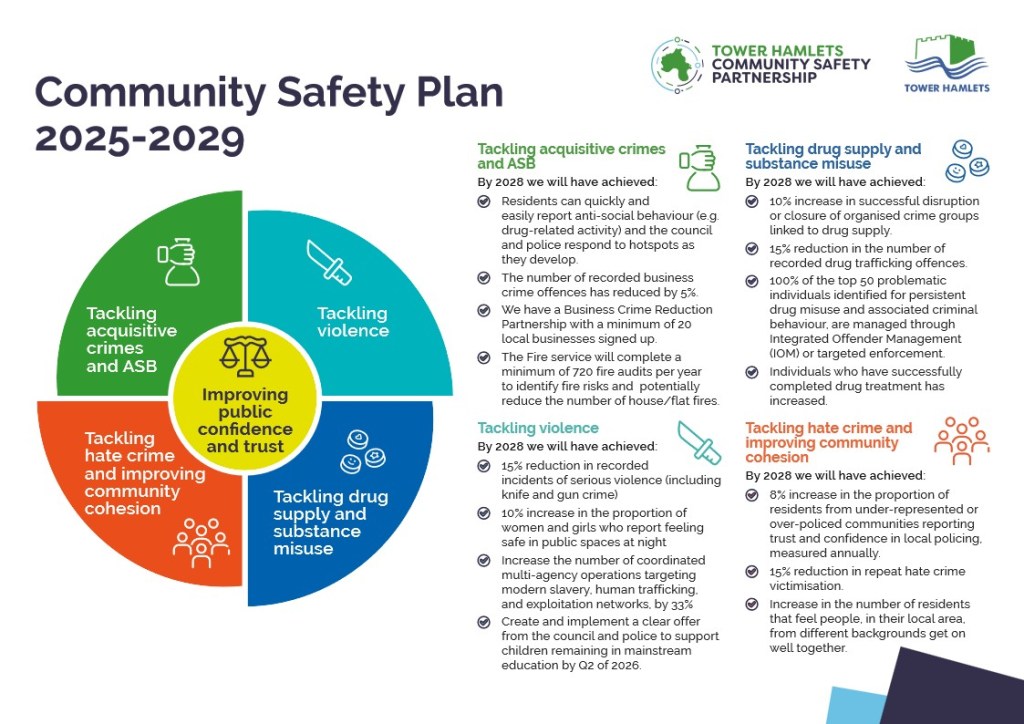
The new version for 2025 – 2029 has just been launched at a meeting of Tower Hamlets Council’s Cabinet on 17. December 2025. webcast
On the 18. December 2025, the Tower Hamlets Safety Partnership held a closed meeting at Tower Hamlets Town Hall, with only invited guests to hail the introduction of the plan. We (Tower Hamlets Crime Watch) were NOT invited as we previously questioned the validity of a section in the Plan, dealing with Hate Crime. Good that we do NOT have to support all Council policies and we are independent.
The Plan highlights four key points, as published on the Council’s Facebook page
- Tackling acquisitive crime
- Reducing violence
- Addressing hate crime and strengthening community cohesion
- Targeting drug supply and tackling substance misuse
These four points are including the large hate crime Dept in 3.
Looking at the full plan here, as also published on our Ward Panel Page.
We have cancelled our membership with the Tower Hamlets Hate Crime Panel, over a definition of hate crime, that is not a hate crime but is placed to demonise ‘right-wing’ politics. Whereby the right-wing is NOT defined in the Council’s document. We must make a clear definition between the right to protest and unlaw activities. We must concentrate on stamping out crime.
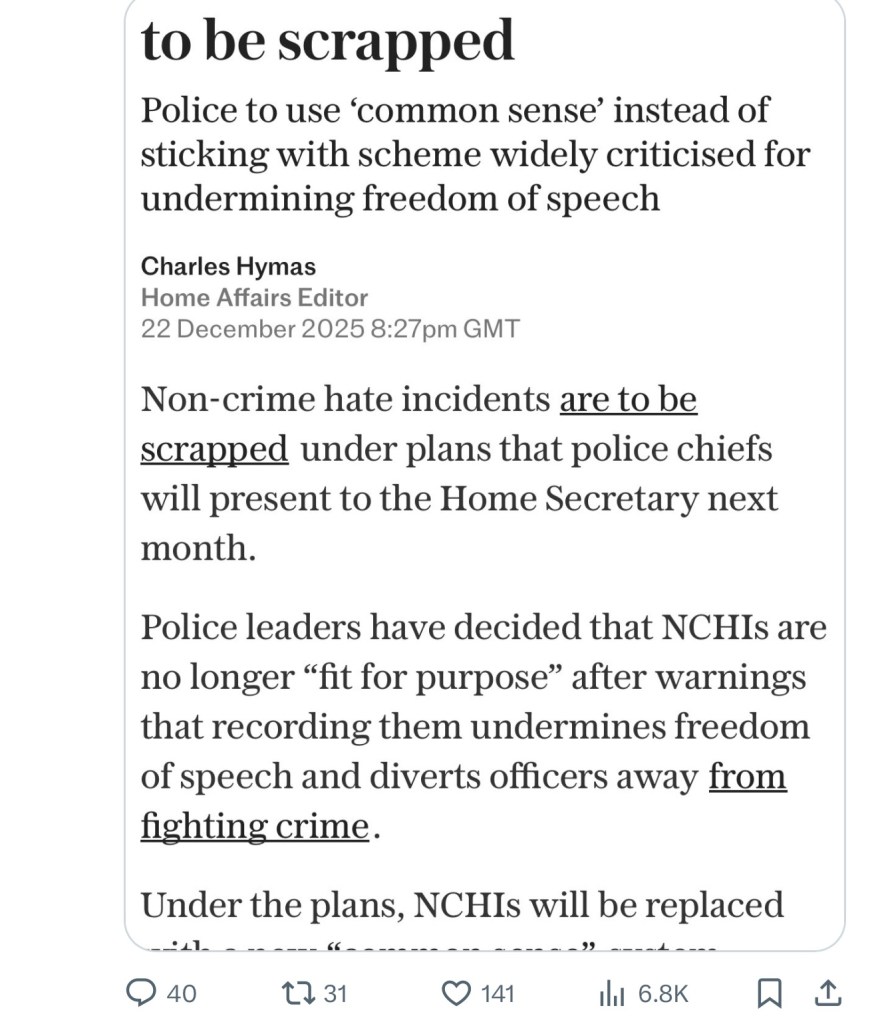
It must also be stated that UK Police leaders call for all non crime hate incidents to be scrapped and the Tower Hamlets Plan relies a lot on non crime hate incidents regulations. See The Guardian article, 23/12/25, furthermore the Community Safety Plan does NOT incorporate a fully endorsed ASB strategy, this has been set back to February 2026 for decision.
Demonisation of any group of people is not helping.
Mary-Ann Stephenson, chairwoman of the Equality and Human Rights Commission, warned the language around migration harms not only migrants but also ethnic minority British people.
This Council and Tower Hamlets Police must act on all threats to our safety. A list of proscribed organisations is published by the gov.uk website and also Anti-terrorism policing publishes lists of extremist symbols and flags.
But we also think that demonisation of political groups or parties in Britain leads to a tit for tat harmful hate acceleration.
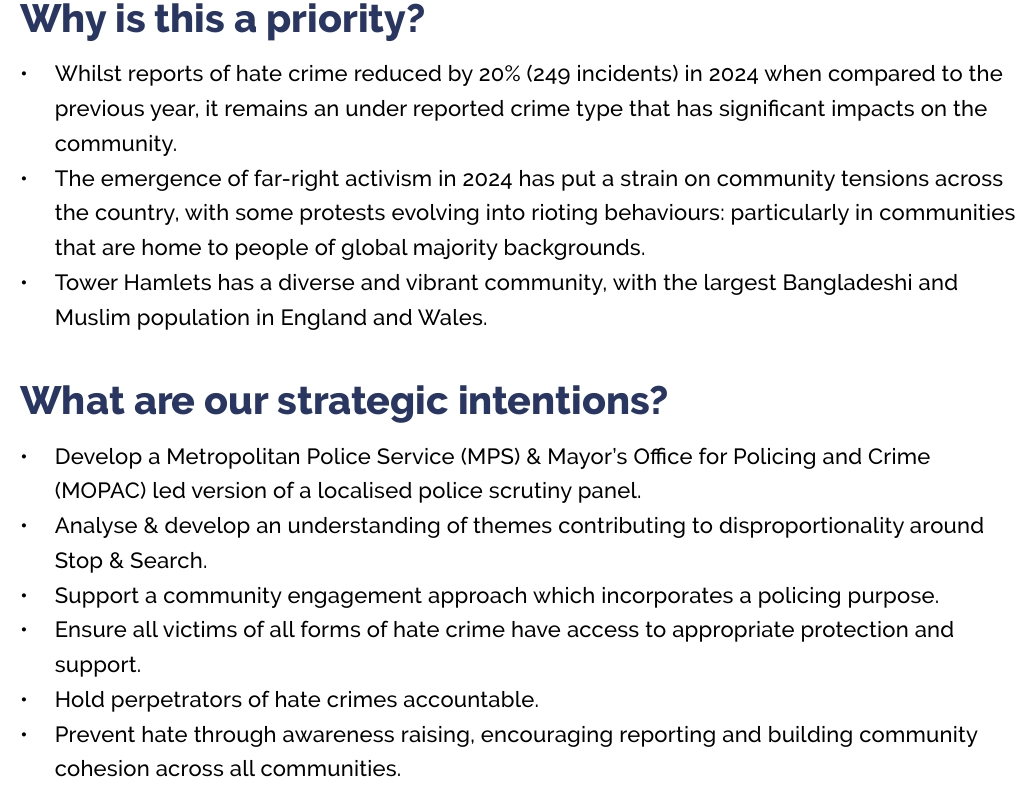
Tower Hamlets Council’s demonisation is stated here on page 38 of the Community Safety Plan and was previously noted in minutes of the Hate Crime Panel meetings, which led us to quit the panel.
Stop & Search
Tower Hamlets Council has advertised for members on the Stop & Search Scrutiny Panel specifically for people who want to see a reduction.
We do not support a reduction of Stop & Search as a matter of general policy.
While the Met has:
• Accepted disproportionality as fact
• Acknowledged systemic racism and the need to eliminate bias/discrimination
• Apologized for specific incidents and broader impacts on communities
They have generally avoided admitting that the disproportionality is due to deliberate or unlawful discrimination by officers as a whole. Instead, explanations often point to factors like crime patterns (e.g., targeting high-violence areas where certain demographics are over-represented as victims/perpetrators), while committing to reforms like better scrutiny, training, and reducing overall disproportionality. Source
The Hate Crime Panel
Seems to be not needed, the Mayor of Tower Hamlets Lutfur Rahman previously boasted how well communities get on and community cohesion is above average good in Tower Hamlets.
” Tower Hamlets is recognized for its strong community cohesion, with 91% of residents expressing that they get on well together, despite being one of the most densely populated areas in the UK.”

The Council blames the ’emergence of far-right activism’ for causing riots in communities with global majority backgrounds.
We cannot support how Tower Hamlets Police promotes the political discrimination of politically motivated criminal activity for the far-right specifically. Previously in the press it appeared that moderate Conservative views were bundled within the far-right category.
Usage and Controversy
The term is sometimes used pejoratively by opponents to stigmatize strong nationalist views, and boundaries can blur (e.g., some populist parties shift toward far-right positions over time). It is not synonymous with all conservatism; many conservatives explicitly reject far-right extremism. In summary, the far-right represents the most intense, exclusionary, and often anti-systemic elements of right-wing thought, prioritizing identity, hierarchy, and national purity over inclusive democratic principles.
General understanding of ‘far-right’
The far-right refers to political positions, ideologies, and movements that lie further to the right on the traditional left-right political spectrum than mainstream or standard right-wing (conservative) politics. It is often described as an umbrella term encompassing a range of views marked by intense opposition to liberalism, egalitarianism, multiculturalism, and progressive social changes.Key CharacteristicsFar-right ideologies typically include:
- Ultranationalism and nativism — Extreme emphasis on national identity, often prioritizing one ethnic, cultural, or racial group while viewing outsiders (immigrants, minorities) as threats.
- Authoritarianism — Support for strong, centralized leadership and “law and order” policies, sometimes rejecting democratic norms like minority rights or pluralism.
- Xenophobia and anti-immigration stances — Opposition to immigration, often framed as protecting cultural or ethnic purity.
- Welfare chauvinism — Belief that social benefits should be restricted to “native” or deserving groups.
- Reactionary or anti-egalitarian views — Rejection of social equality, seeing hierarchies (e.g., based on race, ethnicity, or tradition) as natural or desirable.
In extreme forms, it can involve:
- Supremacism (e.g., white supremacy)
- Antisemitism
- Homophobia
- Or theocratic elements
Historical examples include fascism and Nazism, while modern manifestations include neo-fascism, neo-Nazism, and certain populist radical right parties.Distinction from Mainstream Right-Wing PoliticsMainstream right-wing (conservative) politics generally supports:
- Liberal democracy
- Free-market capitalism
- Traditional values
- Limited government intervention
It accepts pluralism and operates within democratic systems. The far-right, by contrast, often views liberal democracy as flawed or corrupt, seeking more radical changes—either through electoral means (radical right) or violence/revolution (extreme right). Scholars like Cas Mudde highlight a core combination of nationalism, xenophobia, and authoritarian tendencies as defining the far-right, distinguishing it from center-right parties. source
Generalisation
This statement, outright, without exception only blames the ‘far-right’ for stereotypically for all community problems.
We cannot and do NOT support this. There are plenty of examples were far-left activity led to problems.
The Far-Left
The far-right refers to political positions, ideologies, and movements that lie further to the right on the traditional left-right political spectrum than mainstream or standard right-wing (conservative) politics. It is often described as an umbrella term encompassing a range of views marked by intense opposition to liberalism, egalitarianism, multiculturalism, and progressive social changes.Key CharacteristicsFar-right ideologies typically include:
- Ultranationalism and nativism — Extreme emphasis on national identity, often prioritizing one ethnic, cultural, or racial group while viewing outsiders (immigrants, minorities) as threats.
- Authoritarianism — Support for strong, centralized leadership and “law and order” policies, sometimes rejecting democratic norms like minority rights or pluralism.
- Xenophobia and anti-immigration stances — Opposition to immigration, often framed as protecting cultural or ethnic purity.
- Welfare chauvinism — Belief that social benefits should be restricted to “native” or deserving groups.
- Reactionary or anti-egalitarian views — Rejection of social equality, seeing hierarchies (e.g., based on race, ethnicity, or tradition) as natural or desirable.
In extreme forms, it can involve:
- Supremacism (e.g., white supremacy)
- Antisemitism
- Homophobia
- Or theocratic elements
Historical examples include fascism and Nazism, while modern manifestations include neo-fascism, neo-Nazism, and certain populist radical right parties.Distinction from Mainstream Right-Wing PoliticsMainstream right-wing (conservative) politics generally supports:
- Liberal democracy
- Free-market capitalism
- Traditional values
- Limited government intervention
It accepts pluralism and operates within democratic systems. The far-right, by contrast, often views liberal democracy as flawed or corrupt, seeking more radical changes—either through electoral means (radical right) or violence/revolution (extreme right). Scholars like Cas Mudde highlight a core combination of nationalism, xenophobia, and authoritarian tendencies as defining the far-right, distinguishing it from center-right parties.Usage and ControversyThe term is sometimes used pejoratively by opponents to stigmatize strong nationalist views, and boundaries can blur (e.g., some populist parties shift toward far-right positions over time). It is not synonymous with all conservatism; many conservatives explicitly reject far-right extremism.In summary, the far-right represents the most intense, exclusionary, and often anti-systemic elements of right-wing thought, prioritizing identity, hierarchy, and national purity over inclusive democratic principles.
Examples of Modern Far-Right Parties
Compare to Far-Left Ideologies
what is the far left? and what problems were caused by them since 2023
What is the Far-Left?
The far-left refers to political positions, ideologies, and movements that lie further to the left on the traditional left-right political spectrum than mainstream or standard left-wing (progressive or social democratic) politics. It is an umbrella term encompassing views that advocate for radical structural changes to society, often emphasizing extreme egalitarianism, collective ownership, and opposition to capitalism, hierarchy, and imperialism.Key CharacteristicsFar-left ideologies typically include:
- Anti-capitalism and collectivism — Strong opposition to free-market capitalism, favoring socialism, communism, or anarchism, with calls for worker control, wealth redistribution, or abolition of private property.
- Revolutionary or radical change — Support for transformative actions, sometimes through direct action, protests, or revolution, rather than gradual reforms within existing systems.
- Internationalism and anti-imperialism — Emphasis on global solidarity, opposition to Western imperialism, and support for marginalized groups worldwide.
- Identity-based liberation — Advocacy for oppressed groups based on class, race, gender, sexuality, or environment, often intersecting with movements like anti-racism, feminism, or eco-socialism.
- Anti-authoritarianism or statism — Variations exist: Some (e.g., anarchists) reject all forms of state authority, while others (e.g., Marxists-Leninists) support a strong state to achieve equality.
In extreme forms, it can involve:
- Militant activism or violence to achieve goals.
- Rejection of liberal democracy as insufficiently egalitarian.
- Utopian visions prioritizing communal over individual rights.
Historical examples include Bolshevism, Maoism, and anarcho-syndicalism, while modern manifestations include eco-terrorism, antifa groups, and certain socialist parties pushing for systemic overhaul.Distinction from Mainstream Left-Wing PoliticsMainstream left-wing (progressive) politics generally supports:
- Regulated capitalism with social safety nets.
- Democratic reforms for equality and rights.
- Incremental changes like universal healthcare or environmental regulations.
It operates within liberal democratic frameworks. The far-left, by contrast, often views these as inadequate or complicit in oppression, seeking more fundamental shifts—either through electoral means (radical left) or extra-parliamentary actions (extreme left). Scholars like Cas Mudde describe the far-left as combining anti-capitalism, internationalism, and populist anti-elitism, distinguishing it from center-left parties.Usage and ControversyThe term is sometimes used pejoratively by opponents to label strong progressive views, and boundaries can blur (e.g., some activist movements shift toward far-left tactics). It is not synonymous with all liberalism or socialism; many progressives reject far-left extremism.In summary, the far-left represents the most intense, systemic-challenging elements of left-wing thought, prioritizing radical equality, anti-capitalism, and collective liberation over market-based or reformist approaches.Problems Caused by the Far-Left Since 2023Since 2023, far-left or radical left groups and ideologies have been associated with various controversies and problems, primarily in the realm of political violence, disruptions, and societal polarization. Data from think tanks like CSIS indicates a rise in left-wing extremist incidents in the US, particularly in 2025, though overall lethality remains lower than right-wing violence.
csis.org Experts note that political violence is a bipartisan issue, exacerbated by polarization, but far-left actions have contributed to property damage, injuries, heightened tensions, and challenges to democratic norms.
cbsnews.com Below is a non-exhaustive list of key incidents and broader issues, drawn from reported events (focused on the US, as global attributions to “far-left” are less centralized but include similar protest-related disruptions in Europe and elsewhere).Specific Incidents of Violence and Terrorism
- December 4, 2024 – New York City, US: Luigi Mangione assassinated UnitedHealthcare CEO Brian Thompson in a targeted shooting outside a hotel. Mangione’s manifesto criticized corporate greed in healthcare, aligning with anti-capitalist far-left sentiments. This incident, one of only two fatal left-wing attacks since 2020, heightened fears of anti-corporate violence and contributed to debates on extremism, with no other casualties but significant media and public impact. csis.org +1
- January 28, 2025 – Washington, D.C., US: Riley Jane English was arrested on the National Mall with Molotov cocktails and a knife, plotting to assassinate senior officials like Defense Secretary Pete Hegseth (labeled a “Nazi” by her) and others, plus targeting the Heritage Foundation. Motivated by partisan extremism, the disrupted plot underscored rising threats to political figures, causing no harm but amplifying security concerns amid polarization. csis.org
- March 30, 2025 – Albuquerque, New Mexico, US: Arson attack on the Republican Party headquarters, with graffiti reading “ICE = KKK.” Linked to anti-immigration and anti-government motives opposing Trump-era policies, it caused property damage and symbolized escalating partisan violence, though no injuries occurred. csis.org +1
- July 4, 2025 – Alvarado, Texas, US: A group attacked an ICE detention facility with fireworks, gunfire, and graffiti, wounding one police officer. Suspects, equipped with rifles and anti-ICE materials, faced attempted murder charges. Driven by opposition to immigration enforcement, this anti-government incident injured responders, damaged property, and highlighted vulnerabilities in critical infrastructure. csis.org
Broader trends show five left-wing attacks or plots in the first half of 2025 alone, outpacing far-right incidents for the first time in over 30 years, often targeting government or political entities. nbcnews.com +1 These have contributed to at least two fatalities since 2023, property destruction, and injuries, fueling public anxiety and calls for stronger counter-extremism measures.Other Controversies and Societal Impacts
- Campus Protests Over Gaza (2024–2025, US and Global): Far-left-aligned student groups participated in pro-Palestine encampments at universities like Columbia and UCLA, some escalating to clashes with police, property damage, and allegations of antisemitism or harassment. These disrupted academic operations, led to hundreds of arrests, and deepened campus divisions, with critics arguing they stifled free speech and safety. cbsnews.com
- Climate Activism Disruptions (Ongoing Since 2023, Global): Groups like Just Stop Oil and Extinction Rebellion, often tied to far-left eco-socialism, conducted actions like vandalizing artworks or blocking traffic in the UK and Europe. These caused economic losses (e.g., delays in transportation), public backlash, and legal costs, while raising debates on protest tactics versus environmental goals.
- Polarization and Endorsement of Violence: Commentaries highlight how some far-left discourse has normalized or excused violence, contributing to broader societal rifts. thepointmag.com +1 In the US, this has intertwined with anti-government sentiments, exacerbating distrust in institutions. journalofdemocracy.org Globally, far-left populism in elections (e.g., France’s New Popular Front in 2024) has led to policy gridlock and economic uncertainty in coalitions.
Overall, while far-left actions since 2023 have aimed at addressing perceived injustices, they have caused tangible problems like violence (with low but rising incidents), disruptions to daily life, and amplified polarization. Sources emphasize that such extremism risks undermining democratic processes, though it remains less organized and lethal than other threats.
isdglobal.org For context, political violence affects both sides, with data showing right-wing incidents historically more frequent and deadly.
what is the far left? and what problems were caused by them since 2023 in the UK?
What is the Far-Left?
The far-left refers to political positions, ideologies, and movements that lie further to the left on the traditional left-right political spectrum than mainstream or standard left-wing (progressive or social democratic) politics. It is an umbrella term encompassing views that advocate for radical structural changes to society, often emphasizing extreme egalitarianism, collective ownership, and opposition to capitalism, hierarchy, and imperialism.Key CharacteristicsFar-left ideologies typically include:
- Anti-capitalism and collectivism — Strong opposition to free-market capitalism, favoring socialism, communism, or anarchism, with calls for worker control, wealth redistribution, or abolition of private property.
- Revolutionary or radical change — Support for transformative actions, sometimes through direct action, protests, or revolution, rather than gradual reforms within existing systems.
- Internationalism and anti-imperialism — Emphasis on global solidarity, opposition to Western imperialism, and support for marginalized groups worldwide.
- Identity-based liberation — Advocacy for oppressed groups based on class, race, gender, sexuality, or environment, often intersecting with movements like anti-racism, feminism, or eco-socialism.
- Anti-authoritarianism or statism — Variations exist: Some (e.g., anarchists) reject all forms of state authority, while others (e.g., Marxists-Leninists) support a strong state to achieve equality.
In extreme forms, it can involve:
- Militant activism or violence to achieve goals.
- Rejection of liberal democracy as insufficiently egalitarian.
- Utopian visions prioritizing communal over individual rights.
Historical examples include Bolshevism, Maoism, and anarcho-syndicalism, while modern manifestations include eco-terrorism, antifa groups, and certain socialist parties pushing for systemic overhaul.Distinction from Mainstream Left-Wing PoliticsMainstream left-wing (progressive) politics generally supports:
- Regulated capitalism with social safety nets.
- Democratic reforms for equality and rights.
- Incremental changes like universal healthcare or environmental regulations.
It operates within liberal democratic frameworks. The far-left, by contrast, often views these as inadequate or complicit in oppression, seeking more fundamental shifts—either through electoral means (radical left) or extra-parliamentary actions (extreme left). Scholars like Cas Mudde describe the far-left as combining anti-capitalism, internationalism, and populist anti-elitism, distinguishing it from center-left parties.Usage and Controversy
The term is sometimes used pejoratively by opponents to label strong progressive views, and boundaries can blur (e.g., some activist movements shift toward far-left tactics). It is not synonymous with all liberalism or socialism; many progressives reject far-left extremism.
In summary, the far-left represents the most intense, systemic-challenging elements of left-wing thought, prioritizing radical equality, anti-capitalism, and collective liberation over market-based or reformist approaches.
Problems Caused by the Far-Left Since 2023 in the UK
In the UK, far-left extremism (often categorized under “Left, Anarchist, and Single-Issue Terrorism” or LASIT in official reports) remains a low-level threat compared to Islamist or extreme right-wing extremism. Government reports, such as CONTEST and MI5 assessments from 2023–2025, indicate that the primary domestic threats are Islamist (around 75–80% of caseload) and extreme right-wing (10–27%), with far-left or anarchist incidents rarely reaching terrorism thresholds or causing fatalities. No major violent terrorist attacks attributed to far-left groups occurred in this period.
However, far-left-aligned activist groups have been linked to significant disruptions, criminal damage, and public order issues through direct action protests. These actions, while often non-violent in intent, have led to economic costs, infrastructure disruptions, arrests, and debates over protest rights versus public inconvenience. Key examples include:Climate Activism (e.g., Just Stop Oil)
- Just Stop Oil (JSO), an eco-socialist direct action group, conducted numerous disruptive protests since 2023, including slow marches blocking roads (e.g., M25 motorway), vandalizing artworks (e.g., tomato soup on Van Gogh’s Sunflowers in the National Gallery), and interrupting events (e.g., World Snooker Championship, Ashes cricket, and cultural performances).
- Impacts: Hundreds of arrests (e.g., over 677 in late 2023 alone, with rapid arrests under new Public Order Act powers); policing costs exceeding £20 million by late 2023; traffic delays affecting daily life and emergency services; and property damage (though often protected by glass). Critics argue these alienated public support for climate goals, while supporters view them as necessary to highlight urgency.
- In 2024–2025, actions continued (e.g., Stonehenge vandalism in June 2024), leading to long prison sentences (up to 5 years) under anti-protest laws, seen by some as repressive.
Pro-Palestine Direct Action (e.g., Palestine Action)
- Palestine Action, a militant pro-Palestine group using far-left direct action tactics, targeted arms manufacturers linked to Israel (e.g., Elbit Systems factories) with vandalism, break-ins, and sabotage since 2023, escalating post-October 7.
- Impacts: Millions in property damage; factory shutdowns; and broadened targets (e.g., financial firms, universities). In 2025, actions included damaging RAF aircraft, leading to the group’s proscription as a terrorist organization in July 2025—the first for a direct-action protest group. This resulted in thousands of arrests for supporting the group (e.g., over 2,000 by late 2025 for signs like “I support Palestine Action”), raising concerns over freedom of expression and protest criminalization.
- The proscription marked a shift, treating property-focused activism as terrorism, amid debates on UK complicity in Gaza.
Other Issues
- Anarchist or antifa-linked incidents were minimal and not prominent in reports since 2023; no major violence attributed.
- Broader far-left activism contributed to polarization, with some pro-Palestine protests (not all far-left) linked to antisemitism rises post-2023, though causation is complex and involves multiple ideologies.
Overall, far-left actions since 2023 caused substantial disruptions, costs (e.g., policing, damage), and legal precedents restricting protests, but no deaths or injuries from violence. They aimed at highlighting injustices (climate crisis, Gaza) but sparked backlash over tactics, contributing to tougher laws and societal debates. Official sources emphasize far-left threats are low compared to others, with extremism risks undermining legitimate causes. source
Compare with far-right UK threats
Comparison of Far-Left and Far-Right Threats in the UK Since 2023
The UK government’s counter-terrorism strategy (CONTEST, last major update 2023) and MI5 assessments consistently identify Islamist terrorism as the primary domestic threat (around 75% of MI5 caseload and the majority of investigations). Extreme right-wing terrorism (ERWT) is the secondary threat (about 25% of caseload), while left-wing, anarchist, and single-issue terrorism (LASIT) is described as a significantly lower-volume threat, rarely reaching terrorism thresholds.
Official Threat Assessment (2023–2025)
- Far-Right (Extreme Right-Wing Terrorism): Represents ~25–30% of MI5 caseload, ~30% of terrorism-connected prisoners (as of late 2024/early 2025), and a growing proportion of investigations (10–27% in recent years). The threat is diffuse, often online-driven, involving self-radicalised individuals or loose networks. Ideologies include white supremacism, cultural nationalism, and neo-Nazism. Several groups are proscribed (e.g., National Action, Sonnenkrieg Division, The Base, Feuerkrieg Division, Terrorgram collective).
- Far-Left (LASIT): A “significantly smaller portion” of casework than ERWT or Islamist threats. No dedicated proscribed far-left terrorist groups in recent years (though Palestine Action was proscribed in 2025 for direct-action tactics). Threats are often tied to single-issue activism (e.g., climate, pro-Palestine) rather than organised revolutionary violence.
Key Incidents and Problems Since 2023
Far-Left (as previously detailed):
- Primarily disruptive direct-action protests causing property damage, economic costs, and public order issues.
- Examples: Just Stop Oil (road blockades, vandalism; £20m+ policing costs, hundreds of arrests); Palestine Action (attacks on arms factories, leading to proscription in 2025 and thousands of related arrests).
- No fatalities, injuries from violence, or classified terrorist attacks. Focus on criminal damage and disruption; contributed to tougher protest laws and debates on free speech.
Far-Right:
- More associated with potential/planned violence, hate crimes, and terrorism plots, though actual attacks remain rare.
- Notable events:
- 2024 Riots (Summer 2024): Triggered by misinformation after the Southport stabbings, far-right actors mobilised anti-immigrant violence, including attacks on asylum hotels, mosques, and police. Hundreds arrested for rioting, racial hatred, and violence; described as the worst disorder in over a decade, with significant community impact and polarisation.
- Arrests and plots: Ongoing disruptions of ERWT plots (e.g., arrests for preparing acts linked to right-wing extremism). Youth radicalisation is a concern (high proportion of minors in ERWT cases).
- No major successful attacks since 2023, but rising public concern (e.g., 73% of Britons concerned about right-wing extremism in 2024 polls, up from prior years).
- Impacts: Increased hate crimes (e.g., post-riots spikes in anti-Muslim incidents), online radicalisation, and strain on community cohesion. ERWT is seen as the “fastest growing” threat in some assessments.
Key Differences
| Aspect | Far-Left (LASIT) | Far-Right (ERWT) |
|---|---|---|
| Threat Level | Low volume; below terrorism threshold often | Significant; secondary to Islamist |
| Nature of Problems | Disruptions, vandalism, protests | Violence/plots, riots, hate crimes |
| Casualties | None from violence | Rare direct, but riots caused injuries/damage |
| Proscriptions | Rare (e.g., Palestine Action in 2025) | Multiple groups banned |
| Public/Societal Impact | Economic costs, protest restrictions | Polarisation, community safety fears |
| Trends | Tied to activism (climate, Gaza) | Online self-radicalisation, anti-immigrant |
In summary, since 2023, far-left threats have caused widespread disruptions and legal changes but little violent harm, while far-right threats pose a higher assessed risk of terrorism, with major incidents like the 2024 riots amplifying societal divisions. Both contribute to polarisation, but official priorities focus more on ERWT for its violent potential. No far-left actions match the scale or lethality risk of historical ERWT cases (e.g., pre-2023 plots). source
As the Grok analysis mirrors a lower danger level from far-left, we think that any local authority should place a neutrality clause in objecting to any danger to law and order. Situations can change. We must not cling to the past and because things were more dangerous from far-right in the past. It is not always the same.
Interestingly the analysis above places Islamist into Far-Right.
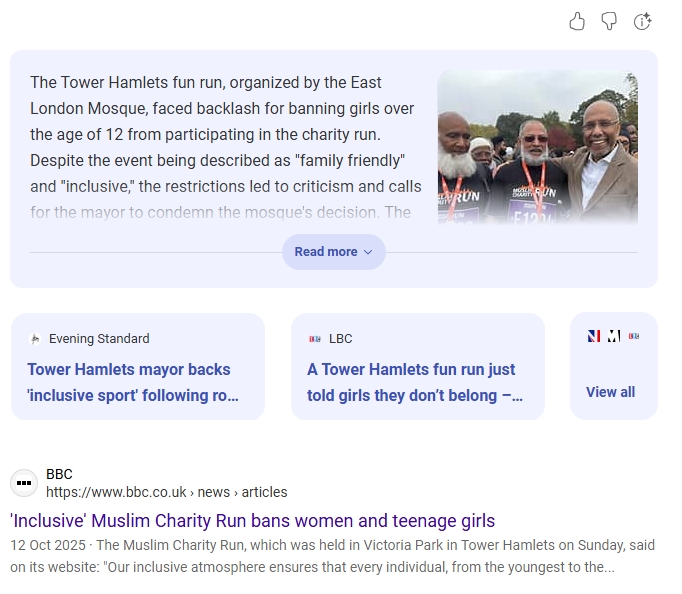
We see a gradual degradation of Women’s rights in Tower Hamlets where recently girls over the age of 12 were banned from a charitable fun run, organised by East London Mosque. Yet the Council put the VAWG department within the Hate Crime section. It’s not quite clear how the thinking works when the Mayor supported that Charity run, which was condemned all over the UK.
We think this council should not place a political preference to hate crime.
As long as the Council’s Mayor supports discrimination against girls this Council has no right to define hate crime against certain political tendencies. This council should oppose all hate crime from all sources and not just concentrate on right-wing hate crime.
We think that Tower Hamlets Council achieves a creeping reduction of equality rights by playing down one threat and concentrating on another whilst at the same time, supporting blatant discrimination against Women and Girls.
The government published in the past a list of prohibited organisations. And constantly up-dates a list of proscribed organisations.

 Tower Hamlets Crime Watch