

More important than holding ward panels would be to collect actual reports of crime, officially made and registered on the Met Police website, rather than rely on submissions made by unverified registrants on Met Engage.
We systematically and permanently remind people to report any crime, suspicion and event that causes concern. Only official statistics will result in police action. See our Tower Hamlets Police page for contact directions.
I now question the efficiency of ward panels altogether. Looking at the description of ward panels below, we can see how much effort, resources and manpower, cost, materials goes into holding ward panels.
Just written a post on my personal blog about Ward Panels, as I seen the post describing Seven Kings Ward in Redbridge.
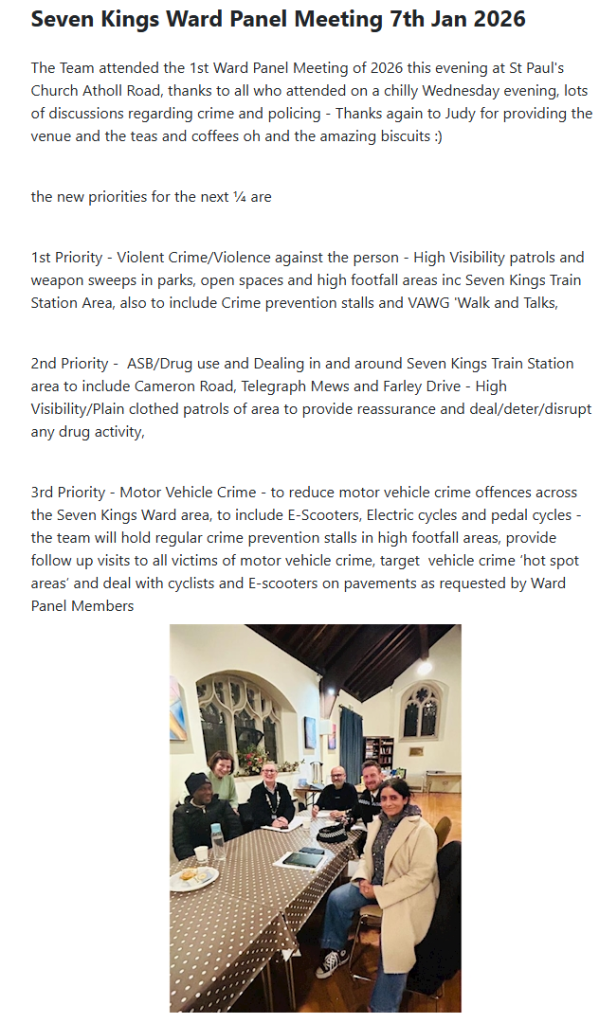
We sometimes see as few as two or three members of the public attending a ward panel, that is attended by police officers, PCSO officers, other providers but actually never exceeds 0.002% of the population.
There is a big gap between a select very few members of the public who keep in close touch with local officers and large widespread community who have little or no permanent connection.
The amount of business in any ward is not measured per ward.
Met Police tries to close that gap of engagement by installing Met Engage but as I have proof, Met Engage, never ever checks the details of it’s registrants. Anybody can register in any area unchallenged. It seems ward priorities are determined by the attendance of a handful of people and submissions made via Met Engage from unknown people and of course the statistics the local police has collected.
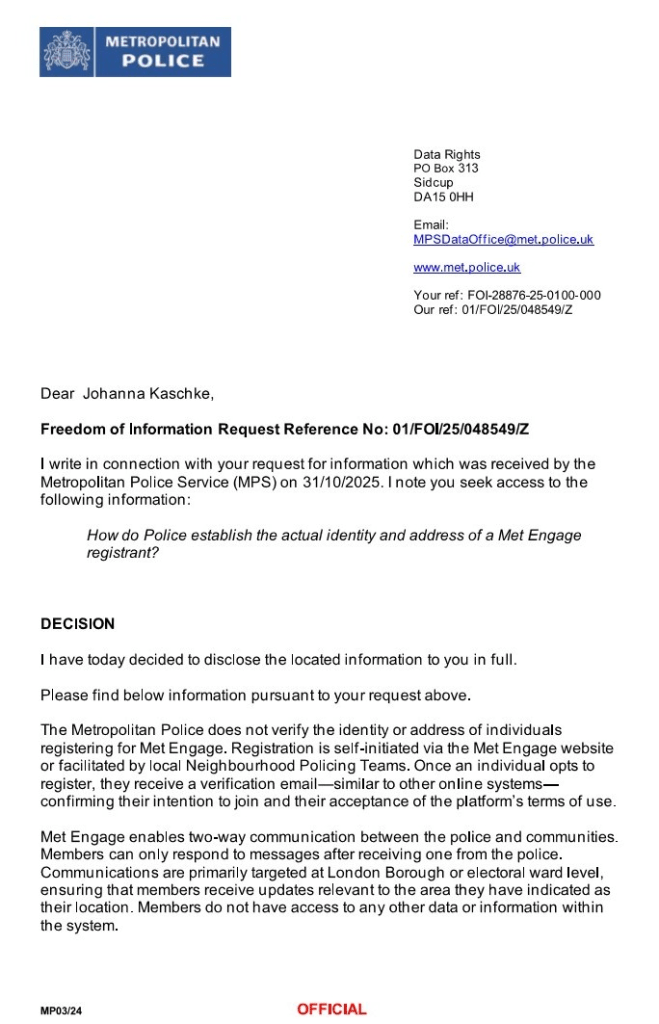
There actually is no official cost analysis for ward panels available, not in police, not London Assembly. Nobody knows how effective ward panels actually are in comparison to cost and effort of holding them.
Sadly any submissions made via Met Engage are not collected in official police statistics and drop under the radar.
Tower Hamlets has 20 wards and each ward has a ward panel, which are the most important tool for public and police interaction on Ward management.
Tower Hamlets has extremely high density (15,695 people/km² borough-wide in 2021, highest in England & Wales), with variations (e.g., higher in central/inner wards like Whitechapel or Spitalfields).
No official public breakdown of the number of businesses (e.g., VAT/PAYE enterprises, local units, or shops) exists at ward level in Tower Hamlets. Borough-wide, there were approximately 16,305 enterprises in 2023.
Tower Hamlets Police currently structure the borough into four clusters, which are colour-coded. Hence, when you visit our Safer Neighbourhoods Page, you see the wards coloured in relation to their cluster colour.
To improve and intensify local interaction with ward management, both
Tower Hamlets Police and Tower Hamlets Council, as well as other providers like housing and social support providers participate in those ward panel meetings, which should be held at least every 3-4 months.
Ward Panel Guidance notes preceded the handbook from 2018
Version 1 of the handbook 32 pages
Version 2 of the handbook 30 pages
is published in the Met Police’s FOI section
This handbook is marked as to be reviewed in 2023.
A very important addition in this v2 is on page 10, where CBV’s, Community Based Police Volunteers are included.
When we now search the Met Police website for Ward Panels we get no result. A FOI request to receive information about the latest version of the Ward Panel handbook has been submitted today, 2. August 2025. This is particularly important as a new Police and Crime Plan 2025 – 2029 has been published by MOPAC. See below.
Tower Hamlets Council has published a Ward Panel Action Plan in 2021.
Because this action plan is from 2021, from the previous Labour administration, we placed a query with the lead councillor Abu Chowdhury, which is to date dormant and has not been replied to.
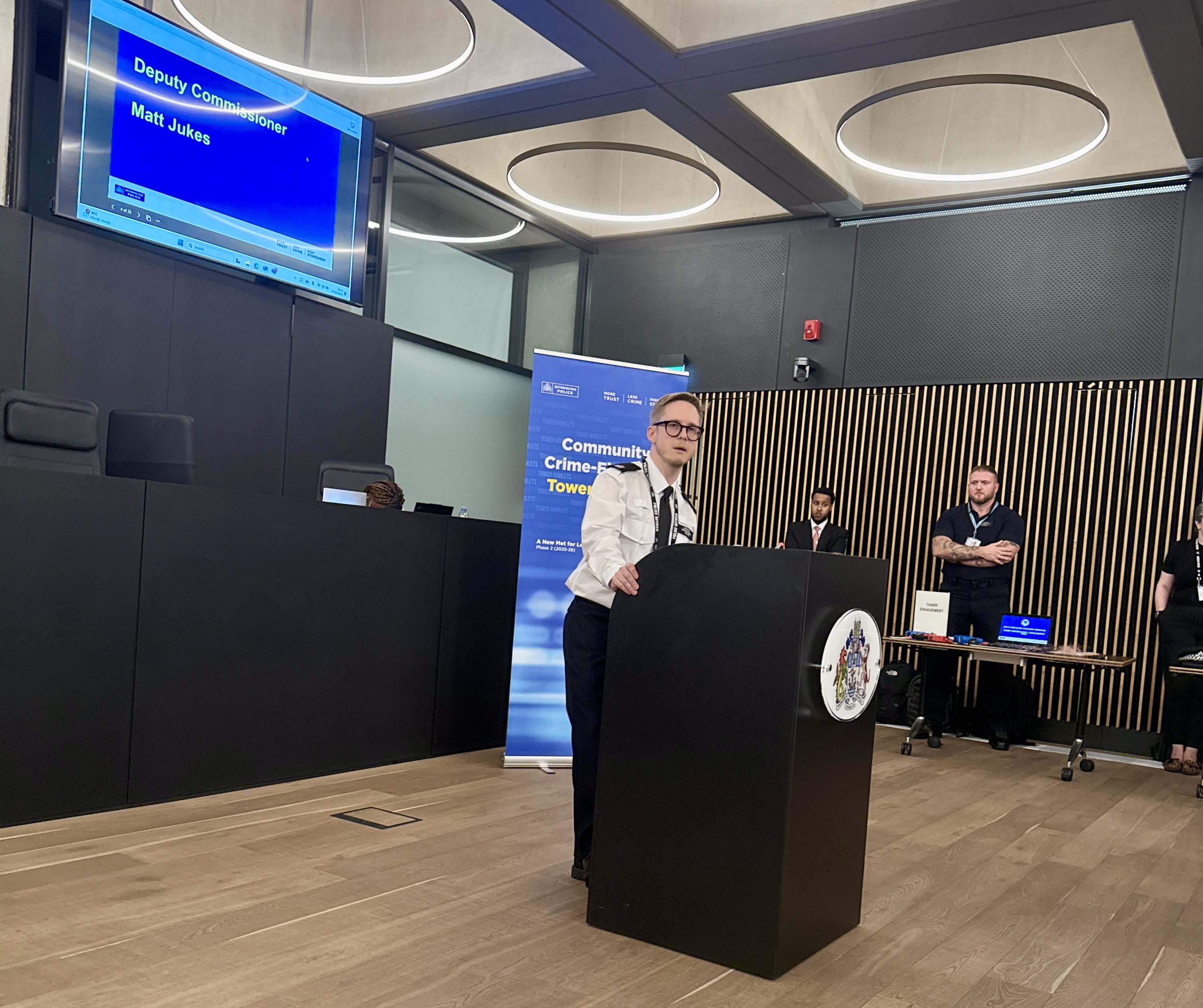 However Superintendent Oliver Richter, Tower Hamlets Police has confirmed to me that he is planning to re-establish all ward panels early in 2026. Also important in this context is the forthcoming meeting on 17. December 2025 where Tower Hamlets Council decides on a definition for ASB in the borough. Adding on 8/1/26, that the Council failed to date to publish a definition for ASB, it has been set back to February 2026 to determine.
Ward Panel structure
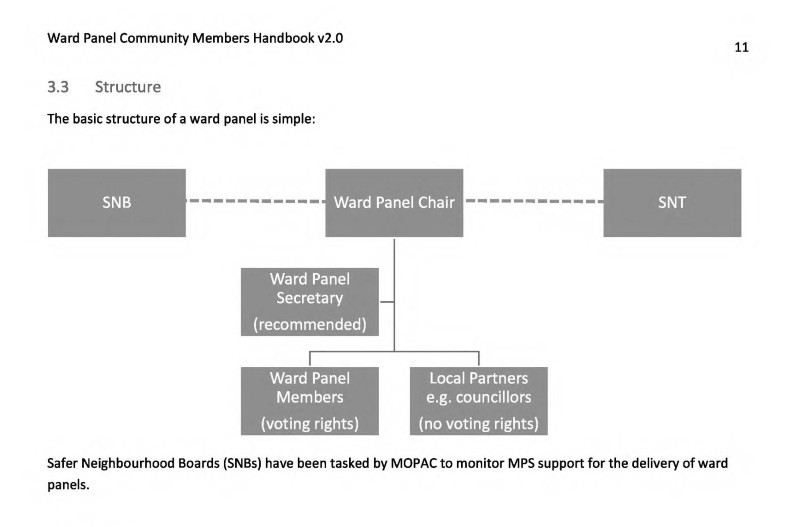
Management of Ward Panels
The Police and Crime Plan 2025 – 2029 – A safer London for Everyone – doesn’t mention the word Ward Panels once.
Ward Panels in Action
The Whitechapel Ward Ward Panel is run exemplary well and is very accessible with large meeting rooms. Anybody interested can attend, though only ward panel members, who reside, word or study in the ward have a vote to set policing priorities.
This is not the case with most other ward panels, some operate in a very obscure manner and are hardly or not at all visible.
I also feel that ward panel borders are not the beginning and end of a ward. What happens in neighbouring wards often considerably affects the crime and policing situation in another.
For example Whitechapel, Spitalfields and Banglatown and Weavers Wards are closely connected with businesses running through the wards like Whitechapel High Street and Brick Lane. Social provision and problem hotspots affect us all. The latest Clear – Hold – Build activity by Tower Hamlets Police in Whitechapel cleared Altab Ali park of criminal activity and homeless tents but problems are rife in Allen Gardens in the neighbouring Spitalfields and Banglatown, which borders Weavers Ward at the north end of Brick Lane.
Ward Panel meetings
Please visit our event calendar for ward panel meetings or visit our Safer Neighbourhood Page. if you click on the ward, that gets you through to the Tower Hamlets Police website, which also lists other engagement events happening in each ward.


 Tower Hamlets Crime Watch