
Counter Terrorism Police have issued guidance for communities and individuals in high tension areas. SAVE CST regularly hold free online courses.


Counter Terrorism Protective Security Advice
Protective Security response to the ongoing UK threat implications from the Middle Eastern conflict.
We recognise that the ongoing conflict in the Middle East has global ramifications to communities and sectors, not least those across our capital city. There are significant on-going community tensions and understandably heightened concerns regarding a perceived or potential increased threat and risk to certain communities across London.
These circumstances have included attacks against Hatzola ambulances in Golders Green and further attempted arson attacks against several other Jewish locations; we also have seen a disrupted attack against the Bank of America in Paris.
The UK National Threat Level (UKNTL) remains at SUBSTANTIAL; an attack is likely.
Please keep updated with latest details
www.mi5.gov.uk/threats-and-advice/terrorism-threat-levels
When out in public
- Stay alert – awareness is your best defence
- Try to stay in well-lit and populated areas
- Leave venues with others wherever possible
- Be confident – even if you do not feel it
- Trust your instincts – if you think something is wrong then act on it
- Have your keys available when you reach your home or car
- Have funds available for transport
- Carry a personal alarm and use it when necessary
- Ensure mobile phones are fully charged
- In an emergency you can use your phone as an Emergency SOS
- NPSA Emergency SOS video at Bing Videos
If you are a victim
- Get help immediately
- In an emergency dial 999 – or ask someone to contact emergency services on your behalf
- Make as much noise as you can to alert people
- As soon as you can, go somewhere you know is safe
- If you are a victim of an attack, where possible do not shower or change your clothes as it may destroy evidence
If conducting public meetings, consider the following
- Use a well-lit room close to other staff areas
- Make sure other colleagues present in the building are aware of meetings and encourage them to report suspicious people or behaviour to you or building security at the earliest opportunity
- Be aware of signs of irrational behaviour
- Conduct a pre-meeting visit to buildings your intend to use to speak to the public and familiarise yourself with its layout. Know the escape route from the building. Be able to retreat quickly into an adjacent room with a solid door that can be locked quickly
- Have sufficient room between yourself and any members of the public
In an emergency or in the event of a terrorist attack
- Stay alert & vigilant – awareness is your best defence
- Remember RUN HIDE TELL Guidance
- RUN – Escape if you can consider the safest options, is there a safe route?
- Do NOT attempt to film the incident
- RUN if you can, if not HIDE
- HIDE – Can you get there without exposing yourself to greater danger? Insist others leave with you, but dont let their indecision slow you down
- HIDE – As soon as you can, go somewhere you know is safe and barricade the door
- Tell – When it is safe to do so dial 999
- Tell – Get help immediately
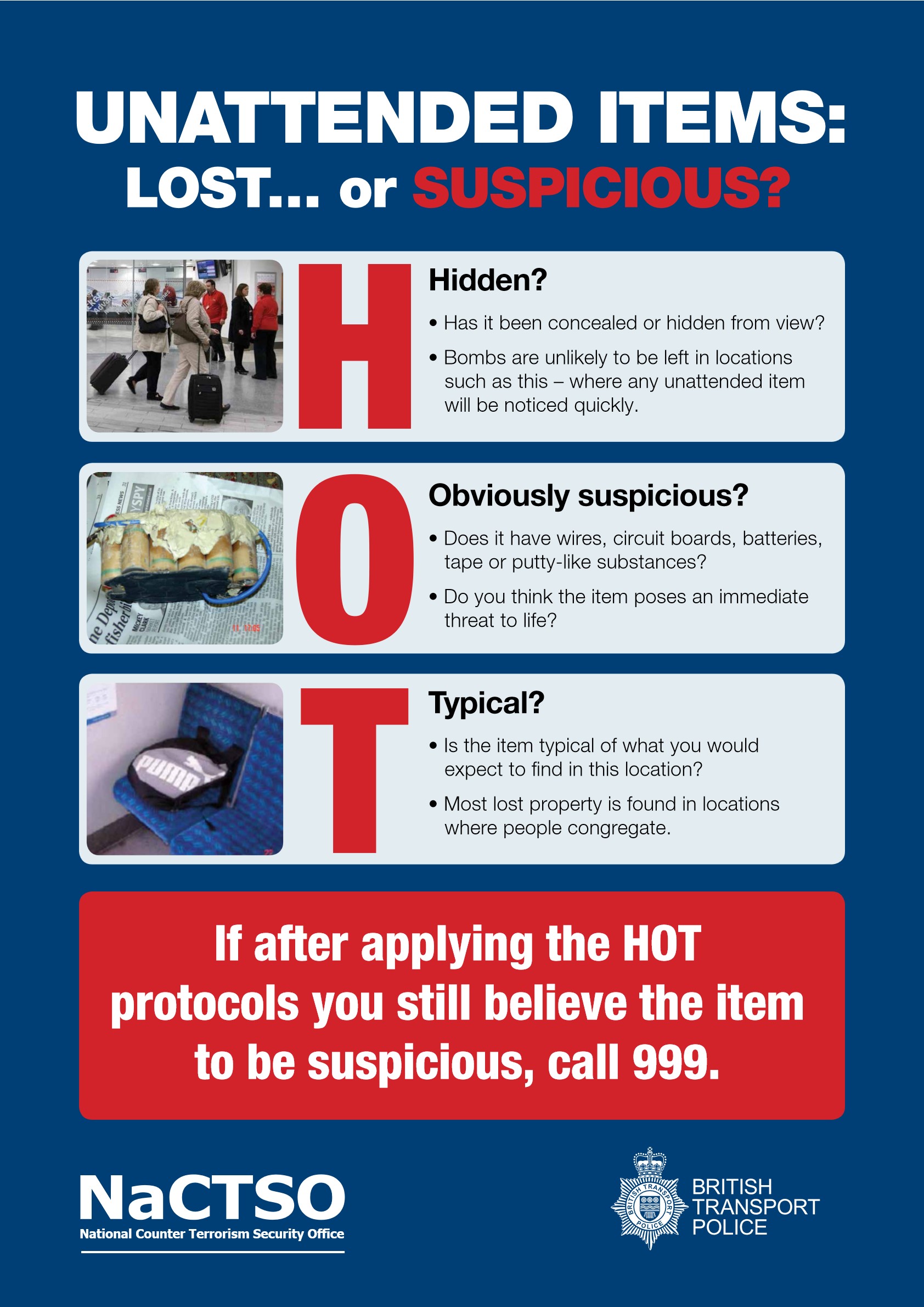
For unattended and suspicious items:
- No unattended item should be ignored, but should always be assessed proportionately
For attacks using Fire/Arson and for Fire Safety advice
- www.npsa.gov.uk/system/files/documents/npsa-fire-weapon-edition-3-aug23.pdf
- www.london-fire.gov.uk/safety/the-home/
- NaCTSO Protect UK: Live information from Counter terrorism (CT) Policing, plus all the latest protective security advice. www.protectuk.police.uk
Personal Security
Cyber/Information security advice
- Get Safe Online: www.getsafeonline.org/
- Cyber/Digital: -Guidance for high-risk individuals on protecting your accounts and devices www.ncsc.gov.uk
Advice to Businesses
- Maintain your risk assessments with ongoing reviews of the current conflict and the impact this has on the UK and your individual business
- Remind staff to remain vigilant and report any suspicious activity via 999/101 or the anti-terrorism hotline on 0800789321
- Ensure all security response plans (especially those for lockdown/invacuation/evacuation) for dealing with terrorism are reviewed, exercised and tested
- Review CCTV, access control and communications systems to ensure they are fit for purpose using the Operational Requirements (OR) process developed by the National Protective Security Authority (NPSA)
- Where appropriate encourage prompt dispersal of crowds and try to eliminate/reduce queueing
- Consider appropriate measures to address fire risks e.g. install fireproof letter box and check all fire/smoke alarms are operating effectively
- Maintain contact with the local Police and local community for information sharing
- Ensure staff complete ACT e-learning training, which includes Run, Hide, Tell (RHT) messaging;
- See Check and Notify for all www.npsa.gov.uk/scan-all-staff
Consider the following useful websites
- Consider and adopt measures to keep your establishment safe using the
- For additional ACT and SCaN training products, contact our Protective Security Engagement Team: psomailbox-.EngagementTeam@met.police.uk
- Police Emergency 999
- Police non-Emergency 101
- Confidential Anti-Terrorist Hotline 0800 789 321
*** Link as on leaflet is not working used shorter version.


1996 Docklands Bombing (South Quay, Isle of Dogs)
• Date: 9 February 1996, at 7:01 pm.
• Perpetrator: Provisional IRA (Irish Republican Army), ending an 17-month ceasefire. It was carried out by the South Armagh Brigade.
• Details: A large truck bomb (around 3,000 lb / 1,400 kg of homemade explosives like ammonium nitrate and sugar, boosted with Semtex) detonated near South Quay DLR station and South Quay Plaza, close to Canary Wharf. Warnings were given ~90 minutes earlier via phone calls with a codeword, but evacuation was incomplete due to confusion.
• Casualties: 2 killed (newsagents Inam Bashir and John Jeffries), over 100 injured (mostly from flying glass). A large crater was left, and the blast was felt across London.
• Damage: Estimated £150 million (buildings destroyed or severely damaged, including parts of South Quay Plaza; Canary Wharf Tower shaken but intact).
• Context and Aftermath: Targeted the financial district to pressure the UK government during Northern Ireland peace talks. It contributed to resuming negotiations (the British government dropped its precondition on IRA disarmament). James McArdle was convicted and later released under the Good Friday Agreement. A commemorative plaque exists at the site.
This remains the primary successful large-scale terrorist attack in the borough in modern history.
Other Related Incidents
• 1999 Brick Lane Nail Bomb (April 1999): Part of a series of racist nail bombings by David Copeland targeting ethnic minority areas. A bomb in Brick Lane (within Tower Hamlets) injured 13 people. It followed attacks in Brixton and preceded one in Soho. Copeland was a far-right extremist aiming to incite race war.
• Plots, arrests, and foiled incidents: Several terrorism-related arrests or plots have involved Tower Hamlets residents over the years (e.g., Islamist-related cases, failure-to-disclose plots, or reconnaissance). The borough has a dedicated Protective Security Manager under the UK’s CONTEST strategy for counter-terrorism advice to businesses and communities. No other major successful attacks match the scale of 1996.
Nearby or Broader East London Context
Major London attacks (e.g., 7/7 bombings in 2005, London Bridge attacks) have not been centered in Tower Hamlets but affected the wider city.

One response to “protective security”
[…] time London’s streets were full of hate preachers. Then the law dealt with them swiftly but terror attacks occurred. We must not let a repetition occur. Abu Hamza had to leave the […]